
CHC33015 Assessment Answers: The Complete Guide to Certificate III in Individual Support
 Min Seow
 06 February,2026
Master CHC33015 Assessment Answers with This 2026 Evidence-Based Study Guide
Completing the Certificate III in Individual Support requires a deep understanding of communication and care planning. Navigating your CHC33015 assessment involves more than just answering written questions; it requires demonstrating role-plays and on-the-job observations that meet modern Australian standards.Students need to highlight their understanding of care plans. They need to highlight their ability to deal with risk and follow safe work practices in real care centres. The first session of the CHC33015 course is confusing to most students. The units involve real aged care incidents. The workload is also a lot for students. For this heavy workload and complex incidents, students often search for CHC33015 assessment answers. When the requirements feel overwhelming, seeking professional assignment writing help can ensure you submit high-quality work that meets all competency standards. This guideline of 2026 simplifies the process and draws a clear road map for your success. This guideline of 2026 simplifies the process. It will also draw a clear road map for your way.
Let’s break this down for better understanding. This guide is for you to easily study Certificate III in Individual Support. These courses are connected to real tasks at the workplace. Your study should show that you know the safety rules and communication needs. You also need to show your care planning and ethical behaviour. In Australia, these expectations have again increased in 2026. Trainers demand more proof and an effective explanation in written tasks.
You will also need to connect your work with the Aged Care Quality Standards. Such standards define day care within aged care homes and community support. Your answer needs to show that you follow standards when planning. You also use these in delivering and reviewing care. This guide has simplified all the steps so that you can easily follow.
Templates and past samples are a preferable choice for many students. They want to download them. Because of this, this blog will guide you on how to get CHC33015 assessment answers PDF from safe and compliant study materials. These files will make you see the structure of proper responses. You will also get updated notes on the CHC33021 training package. It will guide students who are moving to newer materials.
Students look for a simple and easy-to-understand guide. You can get an expert-written PDF or help in CHC33015 assessment answers from MyAssignmentHelp in Australia. These learning materials will help you to improve your study and confidence in any task.
1. CHC33015 Assessment Guide: Understanding the Individual Support Planning Cycle Step-by-Step
Let’s give you a simple explanation: The planning cycle is a significant part of your CHC33015 assessment. It directs workers on the way to support the initial intake of clients. It guides you to support the client’s final review. It is a process that helps you plan care safely. Just as you plan for an individual, managers must plan for the whole organization. You can learn about this larger-scale coordination in our breakdown of managing an operational plan (BSBMGT515A). Demonstrating that you understand both individual care and the structured processes of a care facility will make your CHC33015 assessment answers much stronger. The quality, dignity, safety and good communication are reflected in each step of the cycle. This way of doing the cycle delivers support to you. You can support legal and employment rules.
The cycle is also connected with CHCCCS015 knowledge evidence. It covers the workers’ process of information collection and goal planning. It also shows the way workers offer care, track change, and revise plans. You should show logic, compassion, and precision as you pass through the various stages of the planning cycle. Students must link their work with the Aged Care Quality Standards. It directs all aged care services in Australia.
1.1 How the Person-Centred Support Approach Shapes the Planning Cycle
The base of the entire cycle is the person-centred support approach. It influences all the decisions you make. This method states that the needs of the client are the first priority. Clients’ choices and values also come first. You just do not design a plan for the client. Instead, you design a plan with a client.
This methodology makes this plan fit the lifestyle of the client. It also helps you to make the client feel respected and supported. In composing your CHC33015 assessment, you need to highlight that you listen and give options. You also need to show your ability to clarify options and guide independence. This is in line with the strengths-based approach. You will focus on what the client can do, rather than what they cannot.
The person-centred support approach will be reused in the Planning and Implementation stage. These two steps depend on working with the client. It also includes setting goals and shared decision-making.
1.2 The 5 Stages of the Planning Cycle for CHC33015 Assessment Success
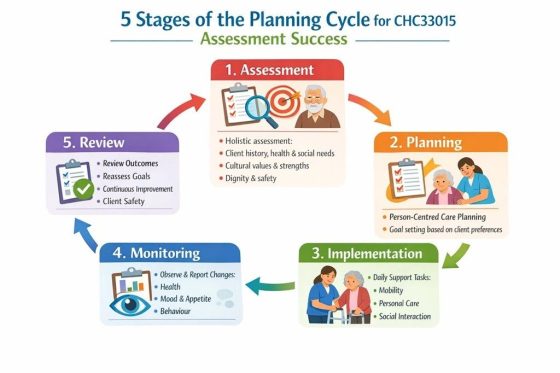
Knowing the five stages of the planning cycle will help you with your written tasks. It will also give you more confidence. Every stage is connected to the practical tasks of workplaces. Now, understand these five stages step by step:
Assessment
This is the starting point. You collect data about the client’s history, health, social needs, and risks. Because health data is so vital, reviewing a professional medical case study can help you understand how to document clinical observations accurately. This phase adopts a holistic method, ensuring you see the client as a complete human being while meeting the Aged Care Quality Standards. The strengths-based approach is also used to find out what the client is capable of doing on his or her own.
This phase needs to connect with the Aged Care Quality Standards. In particular, dignity, safety, and personal choice need to be linked.
Planning
Once you have collected the client information, you come up with the goals. The goals should be clear and complete. Writing SMART goals in your CHC33015 assessment is important for you. The care plan is based on these goals.
This plan should follow the person-centred support approach. It makes sure the preferences of clients guide the decision-making.
Implementation
It is the stage where real support starts. You took part in the daily tasks, such as mobility. You will also support personal care, eating and social tasks. The implementation should be client-focused. This is the other area where a person-centred support approach plays a significant role.
Monitoring
The employees see and understand the customer daily. You seek health, mood, appetite or behaviour changes. Important changes are reported to supervisors. This step states the performance of the plan. It is also one of the pieces of evidence you will be writing in the CHC33015 assessment.
Review
The final step involves reviewing whether the plan is appropriate. You communicate with the client and other employees. You assess the progress and reassess objectives. This step should be associated with the Aged Care Quality Standards, as reviews guarantee the improvement and the safety of the clients.
1.3 Using Aged Care Quality Standards in Client Assessment and Review
The Aged Care Quality Standards are used in two key parts of the cycle. One is assessment, and the other is review. In the process of assessment, the standards make sure that information is collected in a respectable and safe way. In review, the standards help the workers to measure progress. It also guides in modifying the plans and maintaining care up to date.
These standards guide you to organise written work. The better you can use them, the clearer and stronger your CHC33015 assessment answers will be. To see how these regulations impact reporting and liability, check out our guide on legal case study examples. Using these as a reference ensures your work is ready for the high expectations of the Australian workplace
2.Essential CHC33015 Learning Materials: RTO-Approved Resources for High-Quality Assessment Answers
Learning resources are very useful for students. Good resources make the CHC33015 course easy to understand. If you find your current learner guides difficult to navigate, seeking professional assessment help can provide the clarity you need to finish your units on time. Using a mix of RTO-approved resources and expert guidance ensures your written answers are real, updated, and meet industry expectations. These resources easily explain the care planning and safety rules. It also helps to understand the reporting and communication process. With reliable tools, you can have more aligned written answers. It meets the industry expectations.
Most RTOs offer material that meets ASQA requirements. These resources are written in simple words. It also includes real examples and line-by-line information. They help you to understand the theory and use it in real tasks. Good materials also get used in tasks. It supports the knowledge that you need to highlight in your course.
2.1 ASQA-Aligned Tools You Need for CHC33015 Assessment Answers
ASQA-approved tools are very important for this task. These tools help you to complete the CHC33015 assessment in a proper way. These tools also show you how to do tasks in actual workplaces. Common resources include:
- WHS checklists
- Templates of incident reporting.
- Risk assessment forms
- Care plan examples
- Note-taking, communication, and behaviour support.
Such materials make following the safety rules easy. It also makes risk management and information documentation easy to do. They will also make you understand how to respect the choice of the clients.
2.2 Why RTO-Provided Learner Guides Strengthen Your CHC33015 Evidence
The most useful learning tools are the RTO-provided learner guides. These guides include the recent laws, latest procedures, and clear descriptions of support tasks. These are the guides that will allow you to understand:
- The needs and preferences of the clients.
- Care planning steps
- Reporting duties
- Professional boundaries
- Workplace expectations
These guides make your written answers more effective. They make sure that your answer has the right practice. It adds up to the training package. When checking your work, assessors use these guides. The higher you use them, the higher the quality output is likely to be.
2.3 Using Aged Care Quality Standards in Your Written Responses
The Aged Care Quality Standards should be seen in all your written works. They direct your work aspects in supporting the elderly in Australia. In an assessment, while talking about your actions, give the details of how you protect dignity. You also need to describe the way you maintain safety and communicate respectfully. Highlighting the standards in your answers shows your professional side. It shows you can fit the industry expectations.
3.CHC33015 Assessment: How to Balance Dignity of Risk vs Duty of Care in Real-World Scenarios
Maintaining safety and choice is a major part of your CHC33015 assessment. In real care work, the clients can make their own choices. But the workers also need to keep the clients safe. This causes a conflict known as the Dignity of Risk vs Duty of Care. Your task is to help a person become independent. You also need to avoid harm. This section presents the steps of how to deal with this balance in ordinary steps.
3.1 Understanding Dignity of Risk vs Duty of Care for CHC33015 Assessment Success
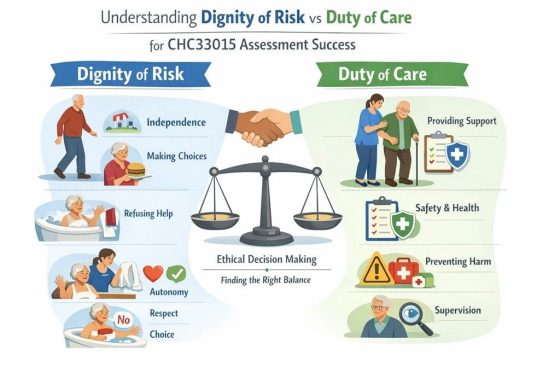
Dignity of Risk is the ability of a client to make their own decisions. The choices are not risk-free. Duty of Care means you should protect the client against danger.
Both are important. You cannot ignore either one. Prove that you can think about both sides before you speak. It is important in your CHC33015 assessment. If you are interested in how these safety balances are managed at a supervisory level, you may find our resource on implementing and monitoring WHS policies (BSBWHS401) helpful for your future career progression into care management.
The following are common examples to be used in case study responses:
- A client wants to walk with no frame.
- A client will select food that is unsafe for their health plan.
- One client refuses to help with the bath.
There must be an understanding, respect and safe decision-making in your answer. You should also connect your actions with the assessment criteria. Maintain clarity in your writing. Give focus to the client’s best interest.
3.2 How the Person-Centred Support Approach Helps You Make Safe Choices
You can find balance through the person-centred support approach. It makes the client the focus of all decisions. You listen first. You do not force the client. You provide options and report risks clearly.
An approach to risk management:
- Hear the client’s choice.
- Ask about the importance of the decision.
- Explain the dangers in a friendly manner.
- Offer a safer option.
- Agree on a shared plan.
- Note down all the information using bias-free documentation.
Such an approach protects the voice of the client. It also shows safe thinking. Your assessor will be checking on your answers. They will look for a clear process.
3.3 Using Aged Care Quality Standards in Your Dignity of Risk Case Study Answers
The Aged Care Quality Standards guide all the care work in Australia. You should use them in your answers. They show that your actions are based on actual laws. It highlights that you follow the workplace rules.
Standards to mention:
Standard 1: Consumer Dignity and Choice- favours independence.
Standard 3: Personal and Clinical Care – supports safe care.
Using these standards in your case study responses makes your answer strong. It shows that you follow both dignity and safety.
Write factually. Use clear observations. Avoid opinions. This is bias-free documentation. It is absolutely needed in each working environment.
4.CHC33015 Assessment Sample Answers: Real-World Scenarios with Person-Centred Support Solutions
One of the best ways to understand the CHC33015 course is to look at real situations that support workers deal with every day. These scenarios show how care decisions are made, how we communicate with clients, and how we record information. They also help you see what assessors expect when you complete your CHC33015 assessment questions.
The examples below are written in a simple, practical way. They focus on real behaviour, clear communication, and person-centred thinking. You can use them as a guide for how to shape your own assessment responses. Let’s give you some scenarios for better understanding.
Scenario 1: Promoting Social Inclusion (CHCCCS015)
A woman named Mary has recently moved into a residential care home. She feels shy around others and prefers to stay alone in her room. Staff worry that she is missing out on social contact. You are asked to help Mary feel more included.
What your assessor looks for:
- Respectful communication
- A warm and gentle approach
- Encouraging, not forcing
- Understanding Mary’s preferences
- Linking your answer to CHCCCS015 knowledge evidence
How you should respond:
Begin by checking on Mary in a quiet and relaxed moment. Sit with her for a short chat, rather than rushing into suggestions. Ask simple questions like, “What hobbies do you enjoy?” or “Is there something that would help you feel more comfortable?”
The aim is to make her feel heard. Instead of pushing her into an activity, offer small steps that match her comfort level. For example, you might invite her for a short walk outdoors, or suggest a quiet craft session rather than a busy group event. You could also pair her with another resident who shares a similar interest.
The key idea is slow, gentle support-not pressure. You then record what you discussed and what Mary preferred. This shows you understand how to encourage social inclusion in a respectful, person-centred way.
Scenario 2: Dignity of Risk Case Study
A man named Peter prefers to walk without a mobility frame. He says the frame makes him feel “old” and embarrassed. The staff feel worried because he has had a small fall before.
What your assessor looks for:
- A balanced approach
- Safe thinking
- Respect for choice
- Awareness of Dignity of Risk vs Duty of Care
- Realistic action steps
How you might respond:
Start by acknowledging Peter’s feelings. Many clients want to stay independent, and it is important to recognise that. Tell him you understand why the frame bothers him. Then explain, in plain and honest language, that there is a risk of falling if he walks without support.
Rather than shutting down his request, offer alternatives. You might suggest using the frame only for long distances or trying a different walking aid that feels more comfortable for him. Another option is to walk with him while he rebuilds his confidence.
Let Peter choose the option that feels right to him, as long as it is reasonably safe. You then record the plan clearly, sticking to facts and avoiding any emotional language. This shows you understand how to balance dignity and safety, which is a major part of the CHC33015 assessment.
Scenario 3: Objective vs Subjective Language in Communication
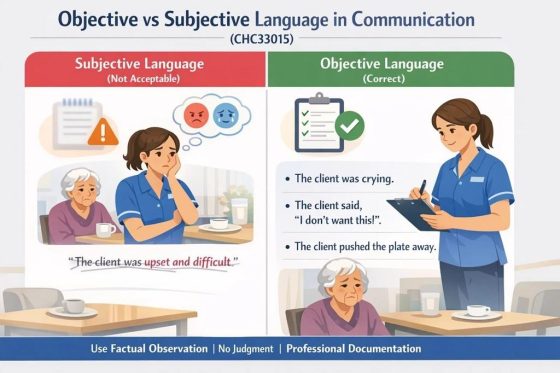
Imagine you arrive in the dining room and find a client crying at their table. Your job is to record what happened.
What your assessor looks for:
- Clear, simple notes
- No personal opinions
- Only facts and direct observations
- Proper communication style
How you might respond:
It is common for students to write what they think is happening, but that leads to mistakes. Subjective language adds judgment. Objective language reports only what you see.
Here is a comparison to help you understand:
Subjective (not acceptable):
“The client was upset, and it was difficult.”
Objective (correct):
“The client was crying and said, ‘I don’t want breakfast today.’ She pushed the plate away with her left hand.”
The objective version is stronger because it shows exactly what happened. It does not assume or judge. This is the writing style used in real workplaces. It also matches the expectations for communication tasks in the CHC33015 assessment.
How do these scenarios link to your Assessment Evidence?
These examples are more than simple stories. They help you build the skills you need to meet both knowledge evidence and performance evidence. Through these scenarios, you show that you can:
- Support emotional needs in a calm and respectful way
- Think through risks using person-centred steps
- Communicate clearly and professionally
- Follow safety and reporting rules
- Respond to real-life changes in a client’s behaviour
- Work in a gentle, client-led manner
- Record information without judgment
These skills appear again and again in your written assessments, your role-play tasks, and your placement workbooks.
How to Use These Examples in Your Own Answers?
When you face case studies in your course, read them slowly and break them into small pieces. Ask yourself what the client needs and how to explain your actions simply. Using basic tips to structure an assignment will help you turn these thoughts into a professional response. Focus on the client’s rights, choices, feelings, and safety, then write your answer using short sentences and calm language. Focus on the client’s rights, choices, feelings, and safety. Then write your answer using short sentences and calm language.
With practice, you will become
5.Workplace Success Tips: How to Apply CHC33015 Assessment Answers During Vocational Placement
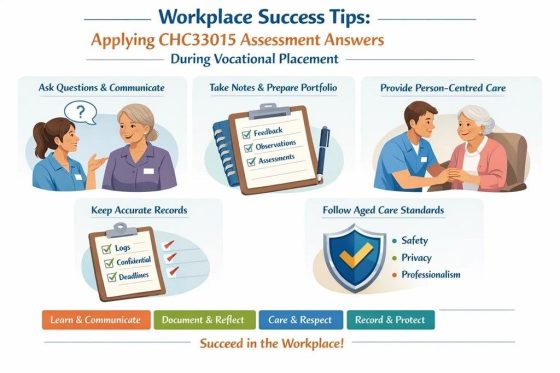
At the workplace, your learning is put into real practice. Most students worry about this point. Let this guide give you a simple understanding without any confusion. CHC33015 assessment answers are simple if you know where you should focus. Your supervisors are interested in seeing that you will learn. They want to see if you can follow rules and treat each client with care and respect. In your task, they want to see your understanding of confidentiality and privacy.
You should start writing by asking questions. It shows your interest and makes you understand the routine. Have a little notebook around. Note down activities, reminders and feedback. This comes with vocational placement when you need to complete your assessment portfolio.
Try to adopt the person-centred support approach in all your actions. Let clients make choices. Listen to what they want. Stay calm, patient, and gentle. Such little details show your professionalism. For those aiming to progress from support work into care coordination or management, reviewing these leadership case study examples can help you understand how supervisors handle facility-wide challenges and team dynamics. You also get performance evidence in the process of placement; just ensure you fill your logbook within the deadline. Record only facts. Secure the privacy by initials and not names.
Last but not least, remember the Aged Care Quality Standards. They act as the shaper of your behaviour, communication and safety practices. Following these standards, you develop trust among clients and employees. Now, you are better at your CHC33015 assessment.
more confident. Each scenario you work through will help you build strong, clear CHC33015 assessment answers that match real workplace expectations.
FAQs About CHC33015 Assessment Answers
Q1: What are the main areas covered in CHC33015?
Ans: The Certificate III in Individual Support helps to learn care planning and communication. It teaches you safety and actual client support. You study theory and vocational placement. It also has a sample guide on the CHC33015 assessment. This educates on how to organise the CHC33015 assessment answers. Your activities are marked as either Satisfactory or Not Yet Satisfactory.
Q2: Where can I find reliable study help for my CHC33015 assessment answers?
Ans: You will have your RTO guide, online learning sites, and individualised support modules. For students who need help with specific, tricky units, a great way to save time is to find answers to homework questions on our platform. These resources align with industry standards and help clarify the technical knowledge evidence needed for your course. It makes the knowledge easy to follow in a few steps. The resources should always align with the industry standards. It supports your CHC33015 assessment answers.
Q3: How do I link my answers to the Aged Care Quality Standards?
Ans: You can connect your CHC33015 assessment answers. You need to highlight the way your behaviours follow the Aged Care Quality Standards. Apply a person-centred support approach. Follow industry laws. You need to show your support for protecting consumer dignity and choice in actual care incidents. You need to input your skills, knowledge and behaviours into real workplace situations.
Conclusion: Your Path to a “Satisfactory” Result
The CHC33015 course is simpler to finish when one knows and can follow the steps, apply the proper tools, and tap into the actual workplace rules. Clear thinking, easy writing, and a focus on client needs build strong CHC33015 assessment answers. You need to use a person-centred approach with the rules. You have to connect your ideas with the Aged Care Quality Standards. It will make your work more confident and professional.
Use a cool and factual manner to write. Highlight your support of dignity, independence and safe care. These tiny practices will help you to create actual and meaningful evidence.
It is possible to have a satisfactory result and feel prepared to work in the support industry. You need to have steady training and the right tips.