
CHCECE038 Assessment Answers: The Complete 2026 Guide to Observing Children
 Min Seow
 09 February,2026
Introduction: Mastering CHCECE038 in 2026
Many students struggle to find CHCECE038 assessment answers that meet the rigorous academic and regulatory standards of the Certificate III in Early Childhood Education and Care. Because this unit is heavily grounded in practical application, generic answer sets often fail to demonstrate the specific competencies required by assessors.
The challenge isn’t a lack of effort; it is often a misunderstanding of what assessors are looking for. They require evidence that you can observe children to inform practice using a factual, evidence-based approach. By mastering these practical techniques, you can move beyond simple observation and begin to brainstorm actionable strategies that support child development.
1.1.Unit Definition & Regulatory Context (NQF/EYLF)
In the Australian context, CHCECE038 assesses an educator’s ability to observe and document the development of children from birth to six years. This process involves gathering information, analysing data, and providing a meaningful interpretation that supports a child’s learning and well-being.
This unit is a cornerstone of the National Quality Framework (NQF), which ensures a consistent standard across all Australian early childhood services. Under the NQF, educators must move away from making assumptions and instead perform actionable programming through ongoing observation and assessment.
The primary regulatory link here is Quality Area 1 of the National Quality Standard (NQS), specifically Element 1.3.1, which mandates that each child’s learning and development is assessed through a cycle of planning, documenting, and evaluation. Furthermore, CHCECE038 aligns with the Early Years Learning Framework (EYLF) 2.0, prioritising a holistic view of a child’s culture, family, and interests to support intentional teaching and curriculum design.
2. Understanding the CHCECE038 Planning Cycle
2.1 Introduction to the Cycle
Curriculum Planning cycle is the main element in CHCECE038. This cycle shows how educators make a planning of experiences based on children’s needs and development. It is not based on any guesswork; rather, it relies on getting an accurate value from observations of the concrete information that is collected from the field. This cycle has five stages, and every stage helps to understand children’s individual needs, learning, interest and development. Every stage is well-connected and depends on the previous cycles. In Early Childhood Education, this planning assures that an educator gives equal importance to assessing children’s needs.
2.2 The 5 Stages In-Depth
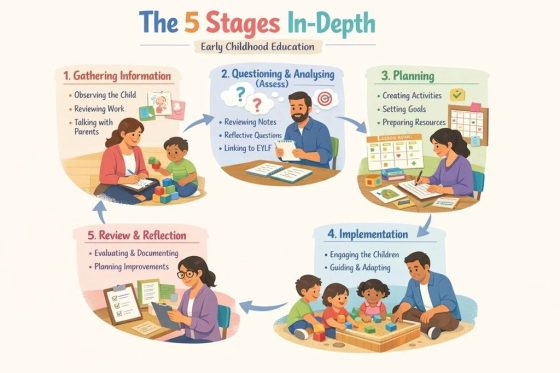
Gathering information: The first stage is to gather information about a child in the natural environment. In this case, an educator collects information through observation, work samples and interaction with families.
Questioning & Analysing (Assess): In this stage, the educator analyses the information collected through observation. It reflects on what the child exactly knows and has learned to date. In short, the overall assessment helps to identify learning goals. This systematic process of processing information and identifying goals is very similar to the clinical reasoning cycle used by healthcare professionals to make informed, evidence-based decisions. It creates a critical link between the observation of learning and alignment with frameworks like the EYLF.
Planning: Based on the assessment, an educator makes a plan of learning experiences. The planning focuses on setting goals, the choice of suitable activities, and the selection of proper resources. The plans are more flexible and support outcomes in developmental areas of learning.
Implementation: This stage involves using experiences into action. It provides meaningful guidance to the children. This inspires them to engage in learning activities. This allows a student to respond on child’s interest. This makes an adjustment where it actually required.
Review & Reflection: This final stage focuses on the effectiveness of the planned experience of gathering pedagogical documentation. This critical reflection allows an educator to understand what worked well or what did not work well. It informs future observations and ensures a continuous learning and teaching process.
2.3. Linking to NQS Element 1.3.1
NQS elements critically focus on an individual child’s learning and development. It develops the planning within the ongoing cycle. This supports each stage of the curriculum planning cycle, and that reflects on the early childhood settings. For instance, during the gathering stage, an educator overall observes children’s activities, and that aligns with the EYLF framework. This gives an idea about which types of learning and development is exactly needed.
Likewise, the analysis and questioning help an observer to identify progress in learning. Based on the experiences of learning, we ensure the decisions are suitable. During the planning stage, an educators make a planning of learning for a child based on the child’s needs and interests. As per EYLF, every child is unique, and in the observation stage, an educator deals with every child equally. They help you to adopt experiences from children with diverse cultures.
An implementation ensures how the plans and experiences support actions. This framework assures that the more positive actions help to get advanced learning outcomes. Finally, reflection allows an educator to analyse how experiences help to support future planning. As per the EYLF framework, a child can focus on developing social skills. This inspires a child to develop problem-solving skills that promote creativity. In the reflection stage, an educator or a learner can understand how creativity matters for a child. This way, a continuous cycle illustrates compliance under the National Quality Standards. It ensures the overall learning of a child will be progressive and supports well-being.
3.Essential CHCECE038 Learning Materials & RTO Resources
3.1. Introduction to RTO Standards
Registered Training organisations or RTOs deliver CHCECE038 units. This performance in the unit needs to maintain a standard. RTOs help to manage recognised training and help to maintain standards. This assures that an educator can gain experience while dealing with children of diverse backgrounds. These actions also help to perform fairly in the field. So, getting a high quality CHCECE038 RTO resource can meet all the requirements. These real competencies maintain standards of childhood care settings. This way, an educator can support the well-being of children.
3.2. The Toolkit: What Students Need
To make a successful completion of CHCECE038, a learner needs to get high-quality CHCECE038 learning materials. That will be offered by their respective RTO. So, to use materials properly and fulfil coursework needs, a learner can use the following toolkits.
- Using detailed guidance that helps to get in-depth knowledge of unit needs. It helps to meet performance criteria and align with the CHC30121 training package.
- Need an assessment task on workbooks. This helps students to apply theories on practices. They need to collect authentic evidence that supports data and proves competencies.
- Utilise assessment documents. It helps a learner to make an alignment between tasks and performance.
- RTO is required to use it as a marking guide. This helps to make a reliable judgment to use information.
- A learner needs observation-recoding tools. This helps to record all the minute details while working in the field.
All of these tools are designed to help you demonstrate competency in childcare settings. If you find the documentation overwhelming, utilizing reliable assignment help in australia can provide you with expert-led templates and guidance. Our experts specialize in aligning your work with the CHC30121 training package, ensuring every observation meets the required regulatory standards.Professional guides can assist in structuring your curriculum plans, managing complex documentation, and ensuring full compliance with child safety policies. For instance, they help you to make a curriculum plan, get documentation and ensure the use of child safety policies. You will surely perform better in the field.
3.3. Why Compliance Matters
Compliance is not optional; rather, it is mandatory. Now the question is, who is responsible for managing compliance? The Australian Skills Quality Authority (ASQA) regulates RTOs and manages audits that meet the national standards. The non-compliant resources or poorly documented observations can lead to create results in assessment invalidations. The use of an authentic CHCECE038 resource will be valid, flexible and fair and support a quality assignment. This proves that a learner has practical experiences. This will be valued by employers and help them to understand that a learner has an ample level of experience in childhood sectors.
3.4. Expert Advice: Seeking Guidance
A student always seeks guidance from well-skilled and qualified trainers while using CHCECE038 materials. This proper guidance helps to avoid errors while conducting learning development. It helps you to meet expectations with professors. They assure the use of evidence to meet compliance requirements. So using RTO approved tools and expert feedback helps to give confidence to the learners. This way, your work will maintain regulatory standards.
4.How to Conduct Effective Observations
Understanding of how to conduct observation is one of the important elements that meets the requirements of CHCECE038 assessment. It is not like to watch passively, rather it focuses on making a direct interaction with the child in natural settings. To conduct an observation process, it is essential to follow some important steps. The proper application of observation techniques helps to meet Performance Evidence standards.
4.1. Step 1: Selecting Your Observation Technique
Observation technique is not just starting to observe randomly. An effective observation starts with choosing suitable observation techniques. It states to understand what exactly the child is doing. It helps to understand the stakeholders who are involved in the process. For instance, in observation, the stakeholders are children, families, and assessors.
To keep records of social interactions, Anecdotal Records will be ideal. This highlights the importance of emotions and developing problem-solving ability to solve real problems. It helps to capture the behaviour of a child in a natural environment. In the next step, it is essential to use jotting; this stage allows one to write details about what they exactly observe. To make the process easier, you can take some brief notes, and that can be explained further to craft a report. In short, Anecdotal records are great for spontaneous social interactions, while Jottings are perfect for busy outdoor play. An educator uses CHCECE038 to choose suitable observation techniques that will be suitable for the environment.
4.2. Step 2: Running Records vs. Jottings
Understanding the difference between Running Records and Jottings ensures observations are accurate and objective.
Running records are considered a detailed observation, and this turns into manageable actions. It offers an objective account to the child. It understands what the child actually does in the field. It collects the detailed description of the child’s activities. These extensive details allow us to get the expected outcome. It will be out of proportion as it is so time-intensive, and make suggestions for valuable learning.
On the other hand, jottings are to get brief descriptions from practical activities. It can be written in a single paragraph. This captures the main actions and quotes. Jottings help to make a document in real time. It helps an educator to take instant notes. This way, both support to give reliable support. As a result, it helps to make a plan for developing potential actions.
4.3. Step 3: Using Photo Observations and Learning Stories
Photo observations are one of the powerful instruments of performing visual evidence. But this is not the half of the handling task. In order to meet expectations, an educator must provide detailed descriptions of the image.
To turn a photo observation into a learning story. Photo observations exactly show the making of an interpretation of child activities and make a ‘Aha’ moment. An interesting description of the image lures the reader to imagine the child’s exact activities. Photos are particularly effective to make documentation for physical development. To use skills like motor skills, co-ordination and complex building blocks work together. This way, learning stories makes relevant documentation for analysing child activities in detail.
4.4. Step 4: Meeting the “Three Focus Children” Rule
Step 4 gives importance to collecting data from three focus children, belonging to birth and six years old. Among all children, at least one infant will be under 23 months. It states that you can not pass without observing children under 23 months. This statement means that at least one infant under 23 is essential for demonstrating CHCECE038 competence. Otherwise, the set of observations will not be completed, and without taking data from a 23 month infant, the whole data can be considered as ‘Not yet Competent’. So, getting detailed knowledge from all these age groups, a complete assessment will be developed that meets the national training standards. As a result, it ensures all the requirements will be met under the regulated service.
5.CHCECE038 Assignment Sample: Real-World Scenarios
5.1. Sample Answer: Identifying Child Interests (Element 1.1)
First scenario:
An educator observed a 3 years old child who was playing in a hospital with a toy like a dinosaur. Two peers join and assist them in building blocks.
Sample answer:
According to the observation, the child is active while playing with peer members. This helps to extract knowledge evidence. It lists the overall interests of a child that includes collaborative play, community skills and play with dinosaurs. The child is also making blocks to represent beds and rooms. It also shows that the child breaks the blocks and again makes this. This shows an instant problem solving skills of a child. Apart from this, the child is enjoying play with the peer groups. The social skills of a child proves that the child is cooperative. He has good negotiation skills that support peer members. This behaviour is critically aligned with EYLF health care settings.
Outcome 1:
This child has good confidence and a sharp mind to learn something new.
Outcome 2:
The child has a strong sense of identity and loves to brainstorm ideas.
Based on the observations, an effective teaching process can be planned. This will extend the interest of the child. An educator can build a habit of reading storybooks among children. In order to improve learning and development, an educator can inspire a child to enhance language. They support learning new vocabulary. A child will be interested in exploring relatable names of toys. Cooperation with other children helps to understand that one child can share meaningful things with another.
Why this works:
These potential actions increase the child’s interest. When an educator reads story books for a child, it influences them to learn about unknown things. This idea is completely prior-based and avoids any kind of assumptions.
5.2. Sample Answer: Using Secondary Sources (Element 2.1)
An educator can review the enrolment form of the child and observe that the family speaks the Cantonese language.
Sample answer:
Here, the enrolment form or the parents’ interview is used as secondary information. This helps to understand the cultural background and home environment of a child. This data can not be done with only observation. If the enrolment form indicates that Cantonese is considered the primary language at home. So, an educator can design a curriculum in such a way that it could be understandable for everyone in the family. Here, understanding this individual need, a child gets early education in Australia. In that case, an inclusive practice helps to make strong decisions to handle children’s development. This practice is aligned with Element 2.0. Here, children are connected with and contribute to their world. The diversity helps to get early education in Australia.
While crafting curriculum planning, it is essential for an educator to make a curriculum in bilingual language. Likewise, they share storybooks and others also in Cantonese. In case of family collaboration, they need to give equal importance during the celebration of a program.
Why it works:
Using secondary sources like enrolment forms helps create a holistic plan for a child’s wellbeing. This evidence-based approach to documentation is a core skill in many clinical fields; if you are struggling with similar analytical tasks in your health units, you can find expert nursing case study help to master the art of data-driven reporting. Hence, this focuses on the knowledge and an evidence based planning that supports the learning materials like CHCECE038.
5.3. Sample Answer: Objective vs. Subjective Recording
The goal:
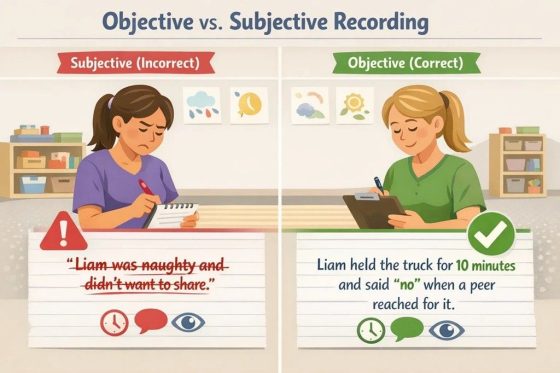
It considers a bias-free documentation. This avoids the negative labelling of before and after comparison.
Subjective: (Incorrect)
For example, Liam was naughty today and didn’t want to share.
Objective (Correct statement):
“Liam held the truck for 10 minutes and said ‘no’ when a peer reached for it.”
Explanation:
The first statement uses negative labelling, such as using terms like ‘lazy’. Here, the educator is biased to share thoughts about the child. This biased approach breaches the professional documents standards.
However, the second statement records the detailed behaviour of a child. This records the child’s language, time-sense and other aspects. It helps to understand the core reasons behind issues faced by children.
So, here, it can be stated that objective recording creates a more strength-based approach. It identifies the child’s skills of negotiation, learning and others. This helps to meet the expectations of professional documents of CHCECE038. Based on the problem, an educator can suggest the area of development. They can design a curriculum in such a way that will solve child problems in the future.
Why it works:
This comparison is necessary to understand the difference between biased and bias-free documentation. This helps to meet the requirements of professional documents. The quality answers will meet the expectations of the CHCECE038 assignment sample AU. This guide helps an educator to make an assessment that supports the planning and well-being of the child.
6.Managing Bias and Subjectivity in Documentation
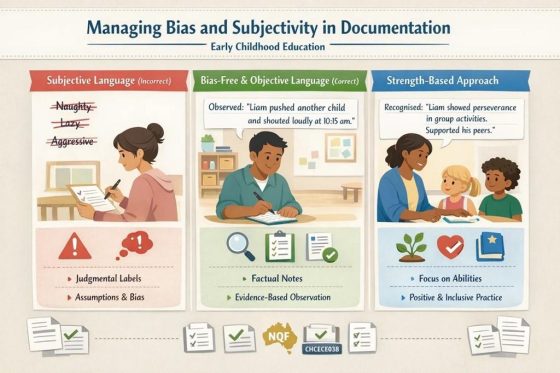
Managing subjective versus objective language is one of the critical elements in developing documents. An assessor is looking for fact-based documents that align with Australian early childhood standards. Using subjective language assures the use of emotions and assumptions, whereas objective language focuses on accurate recording, which is exactly what the study of childcare settings demands. For example, ‘a child was lazy or naughty’, it is a very subjective statement. But the objective language of this version will be ‘the child is never praised by educators due to performing very disturbing behaviour’. This way, it will help to make an assessment-ready paper for submission.
Why do labels fail? Avoidance of bias-free writing
In the case of studying an individual child in the field, you may find a naughty child. So, in that aspect, an educator can label them as naughty, lazy, aggressive and others. Using these terms can reveal biased behaviour of educators. Of course, this is not right. A biased judgment can never make an inclusive decision. These unusual terms are known as avoidance of labelling. In many cases, professionals do not show their professionalism while dealing with labelling.
This could be avoided by adopting a bias-free perspective. In that case, the National Quality Framework can offer bias-free documentation to educators. This guide helps an educator to use labels ethically and never breach ethical expectations. In CHCECE038, ethical aspects will align with Performance Criteria 3.3. As a result, you will make accurate and bias-free decisions. It helps to manage an expected performance.
Strength-based approach (the correct solution)
A strength-based approach shifts the documentation into a more professional way and recognises the capabilities of children. It keenly observes the challenging behaviour of children. This inspires educators to develop constructive thinking. For example: instead of writing about an aggressive child, you can write that the balancing behaviour of the child helps to manage wellbeing.
This approach aligns with the framework of EYLF. This documentation considers inclusive practice. This helps you to deal with every child equally. In this way, it allows you to set professional aims that follow a proper curriculum planning. This helps to manage compliance standards while fulfilling expectations of learning development.
Grounding documentation in Australian Standards
In order to meet CHCECE038 requirements, a set of observations directly reflects on EYLF, NQF and other standards. The Australian standards focus on objectivity and developing bias-free aspects. It assures the observation will be based on valid evidence and avoids any personal opinions. Here, the final documentation makes a link between observations and control information practices or applications.
7. Expert Tips: How to do CHCECE038 Assessment Successfully
7.1. Introduction to Expert Success
Many students ask, ‘How to do the CHCECE038 assessment?’ without feeling overwhelmed. Making an anxious to deal with assessment is completely valid. This unit is the combination of using theories of child care settings and applying those to inform practices. Besides, students face issues in maintaining compliance standards while doing informed practice. To manage this, students are looking for reliable assessment help in Australia. In that case, they can take assistance from MyAssignmentHelp, a professional service that helps you to manage assessments using evidence. It inspires a real educator to use an ideal problem-solving approach to solve real problems in the field. Success in this unit requires more than just filling out forms; rather, it requires a strategic approach to developing documentation. Lastly, crafting professional documentation is essential for achieving expert-level success in CHCECE038.
7.2. The Expert Checklist
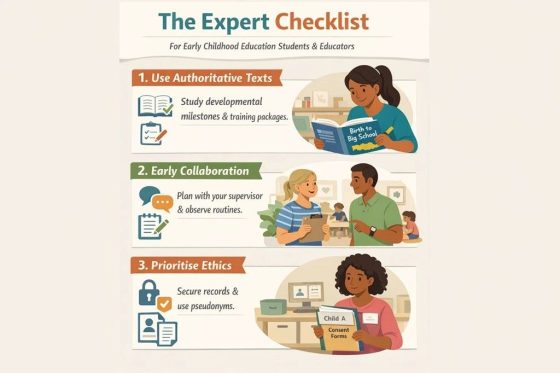
Tip 1: Use Authoritative Texts. “Before starting your jottings, review the ‘Birth to Big School’ textbook. This resource is invaluable for identifying developmental milestones that align with the CHC30121 requirements.” This is particularly valuable for identifying developmental milestones. Getting the CHCECE038 training package ensures an accurate answer. This makes me reflect on the professional theories.
Tip 2: Early Collaboration. “Don’t wait until the last week of placement. Collaborate with workplace supervisors early to identify which children will be your focus subjects. Their insight into a child’s routine can provide deeper secondary sources for your report.” So, supervisors’ understanding of childhood
routines and strengths help you to make bigger responses. It guides you to build essential communication with children in the field. The regular interaction with children minutely observes their problems. This helps you to develop a problem solving approach that handles these regulatory practice standards.
Tip 3: Prioritise Ethics. “Above all, ensure confidentiality and privacy for all child records. Always use pseudonyms (e.g., ‘Child A’) and ensure no photos show a child’s face unless you have written parental consent stored in the service records.” Along with a photo, an educator can smartly use photo evidence. Before conducting a study, an educator must obtain written parental consent. This assures ethical consents that maintain confidentiality protocols. It guarantees that all data of children is secured properly in the safe system. This satisfies the parents for answering any questions without hesitation.
7.3. Final Success Strategy
By following these practical steps, you’ll find that providing CHCECE038 assessment answers becomes a natural reflection of your daily practice as an educator. This helps you to make advanced planning before conducting an observation. Ethical and professional documents help to gain realistic, measurable and achievable objectives of assessment. A reliable assessment helps Australia help to increase confidence among learners.
Frequently Asked Questions – CHCECE038 Assessment Answers
Q1: How many children do I need to observe for the CHCECE038 assessment?
Ans: For the CHCHCECE038 assessment requirements, a learner must observe three focus children under the CHCECE038 training package. These observations are regulated under early childhood education and care services. To make a successful completion, at least one child under 23 months will be needed. This helps to maintain the compliance standards of the study.
Q2: What are the primary and secondary sources used in CHCECE038?
Ans: In primary and secondary sources in childcare, primary sources are observations, conversations, and a child’s portfolio. The secondary sources include enrolment forms, curriculum planning, child records, documentation and many more. Both are using a holistic view of the child. This is required to maintain the National Quality Standard.
Q3: What observation techniques should I include in my CHCECE038 portfolio?
Ans: Your CHCECE038 portfolio evidence focuses on the childhood observation technique. These can include anecdotal records, jottings, learning stories and many more. These methods help to manage document developmental milestones. It proves the capability of educators regarding observation, recording, and making an interpretation about children’s learning and development.
Q4: How do I link my observations to the EYLF?
Ans: To achieve success in linking observations to EYLF 2.0. It identifies exactly what children are doing. The collection of this data is aligned with the Approved Learning Framework Outcomes (1-5). The use of the curriculum planning cycle explains how this cycle informs assessment tasks. This way, it helps to make a future plan for the study.
Q5: What is the difference between subjective and objective language in observations?
Ans: In subjective vs objective language in childcare, the subjective language focuses on opinions or labels, but the objective is focused on factual data, observational behaviours and many more. The bias-free documentation meets performance evidence requirements. This avoids the team like negative labelling. It is based on a strength based approach that will be aligned with Australian RTO assessment standards.
Q6: Can I use simulated records if I don’t have access to a workplace?
Ans: Yes, you can use simulated records despite not having workplace access. In order to understand CHCECE038 simulation requirements, some RTOs focus on simulated records. This is possible while it meets the assessment requirements. Simulated records are focused on regulated education and care services. This is supported by authenticated third-party reports. Many workplace placement assessments require real childhood observations. This can be confirmed by the RTO first.
Conclusion: Your Path to a “Satisfactory” Result
Achieving a desirable result in the CHCECE038 assessment answers is not just about filling out a form with what they actually observe. Rather, it is all about making ethical practices that support children’s well-being. By using professional documentation, an educator understands the ethical approach. By using this, an educator knows well to give importance to individual children’s learning and development equally. The assessment answers get the idea of knowing the right approach to implementing actionable solutions to solve child development problems. The overall application of observations helps to give satisfactory results. The use of required things fulfill expectations of early childhood educators under regulated settings. This supports the long-term growth of a career.