
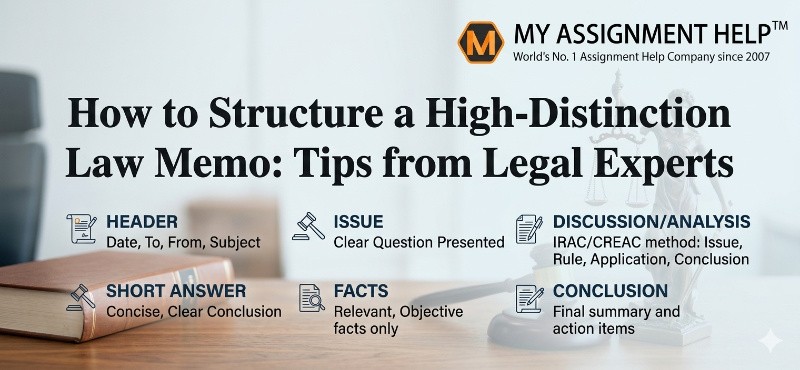
How to Structure a High-Distinction Law Memo: Tips from Legal Experts
 Min Seow
 04 April,2026
Writing your first legal memo can feel like learning a new language. I remember sitting in the law library during my first year, staring at a fact scenario and wondering how to turn a mess of names and dates into professional advice.
In this guide, I will share the exact blueprint I use to write memos that win cases and earn top grades. We will cover the standard law memo format Australia requires, dive into the IRAC vs MIRAT Australia debate, and look at the “hidden” steps that lead to a High Distinction law assignment.
What Exactly is a Legal Memo?
A legal memo is an objective document. It is not a letter to a friend or a creative essay. Its goal is to analyze a legal problem and predict how a court would likely rule. Take help from legal assignment help experts, if needed.
In my experience, students often make the mistake of “advocating” for their client. They try to win the case on paper or a business law case study. However, a senior partner doesn’t want you to tell them what they want to hear; they want to know the truth. If the law is against your client, you must say so. This honesty is the foundation of EEAT (Experience, Expertise, Authoritativeness, and Trustworthiness) in legal writing.
Why the Structure Matters for Your Grade
Lawyers are busy people. If a senior partner has to hunt for your conclusion, you have already lost. A clear structure shows that you have an organized mind. In Australia, markers look for a logical flow that moves from the “What” to the “How” and finally the “Now what?”
The Professional “Look and Feel”
Before a marker reads a single word, they see the layout. Use these settings to ensure your memo looks professional:
- Font: Arial or Times New Roman, 12pt.
- Margins: 2.54 cm (standard).
- Spacing: 1.5 or double spacing.
- Headings: Use bold subheadings for every section.
The Master Anatomy of an Australian Legal Memo
To get an HD, you must follow the law memo format Australia expects. Here is a breakdown of every section you need to include, with tips on how to master each one.
1. The Formal Heading
Every memo starts with a header. It seems small, but if you get this wrong, you look like an amateur.
- To: [Name of the Senior Partner or Tutor]
- From: [Your Name]
- Date: [The Date of Submission]
- Re: [Client Name] — [Short Description of the Matter]
2. The Question(s) Arising
This is where you define the scope of your memo. Don’t just ask “Did he break the law?” Be specific and use legal terminology.
Example: “Whether the actions of the Defendant on 5 May 2025 constitute a breach of the duty of care owed to the Plaintiff under the Civil Liability Act 2002 (NSW)?”
3. The Brief Answer (Executive Summary)
In the real world, a partner might only have time to read this section. Give the answer immediately. Start with “Yes,” “No,” or “Likely.” Follow it with a very brief summary of your reasoning.
4. Statement of Relevant Facts
This is a major grading point. You must separate the “noise” from the “material facts.”
- Relevant Facts: Facts that change the legal outcome (e.g., the speed of a car).
- Background Facts: Facts that set the scene but don’t change the law (e.g., the color of the car’s interior).
For a High Distinction law assignment, keep this section chronological and objective. Do not use emotional language. Instead of saying “The poor victim was terrified,” say “The Plaintiff stated they felt a sense of fear.”
5. The Discussion (Analysis)
This is the longest part of your memo. It is where you show your research and logic. We will discuss the best frameworks for this section (like IRAC and MIRAT) in detail below.
6. Conclusion and Practical Recommendations
End with a summary of your findings and, most importantly, give clear advice. What should the firm do next? Should they settle out of court? Do they need to hire an expert witness? This shows you are thinking like a lawyer, not just a student.
To understand each law type properly or to do an assignment you can take help in the following:
Commercial Law Case Study Help
IRAC vs MIRAT Australia: Choosing Your Framework
One of the most common questions I get asked is, “Which framework should I use?” In Australia, both are common, but they serve different purposes.
The Comparison Table: IRAC vs MIRAT
| Memo Section | Key Requirements |
|---|---|
| Header | Standard format including Date, To, From, and Subject. |
| Short Answer | A brief, clear conclusion that answers the legal issue immediately. |
| Issue | The specific legal question the memo aims to address. |
| Facts | Objective summary of relevant facts only; avoid bias. |
| Discussion | Detailed analysis using IRAC (Issue, Rule, Application, Conclusion). |
| Conclusion | Final summary and recommended legal action items. |
Why I Recommend MIRAT for HD Grades
In the Australian legal system, the “Material Facts” are everything. By using MIRAT, you explicitly show the marker that you have identified the most important details of the case and legal case study examples before you even start talking about the “Rule.” This demonstrates a higher level of critical thinking. At times, you might need to write a law dissertation.
How to Conduct Research Like a Legal Expert
You cannot write a high-level memo without deep research. In Australia, this means going beyond Google. You need to use professional databases to ensure your advice is current.
1. Finding Case Law
Use AustLII for a general search, but for an HD, use LawCite or CaseBase. These tools tell you if a case is still “good law.” If a case has been overturned by a higher court, and you cite it as being active, you will lose significant marks.
2. Statutory Interpretation
If your memo involves an Act of Parliament (like the Corporations Act 2001), you must check the “Current” version. Australian laws change frequently. Use the Federal Register of Legislation to ensure you are looking at the most recent amendments.
3. Using Secondary Sources
High-distinction students use journal articles and textbooks to explain why a rule exists. This is called “policy reasoning.” If you can explain the policy behind a law, you show that you truly understand the legal landscape.
Step-by-Step Guide: How to Write a Legal Memo
If you follow these steps, you will stay organized and avoid the “blank page” panic.
Step 1: Brainstorming and “Issue Spotting”
Read the fact scenario three times. On the first read, just get the story. On the second, highlight any names, dates, or numbers. On the third, look for “legal triggers”—words or actions that suggest a law has been triggered.
Step 2: Drafting the Rule Section
For every issue, you must state the law. Don’t just quote a statute; explain how it has been applied by the courts.
- Pro Tip: If you are citing a High Court case, use the Commonwealth Law Reports (CLR) citation. It is the most authoritative version in Australia.
Step 3: The Application (The Core)
This is where students either win or lose their HD. You must link the law specifically to your facts.
- Pass level: “The law says cars must stop at red lights. The defendant did not stop.”
- HD level: “Applying the rule from Case Name, the defendant’s failure to stop at the 12:05 PM red light constitutes a breach because…”
Step 4: Addressing Counter-Arguments
A great memo is balanced. What will the other side say? If you ignore the weaknesses in your case, you aren’t doing your job. State the counter-argument, and then explain why your original conclusion is still the most likely outcome.
Step 5: Formatting and Citations
In Australia, we use the Australian Guide to Legal Citation (AGLC). Currently, we are on the 4th edition (AGLC4). If your footnotes are messy, it signals to the marker that your thinking might be messy, too. Take the time to get every comma and period in the right place.
10 Common Mistakes That Stop You from Getting an HD
I have reviewed thousands of student papers, and these are the “grade killers” I see most often:
- Using Emotive Language: Avoid words like “unjust,” “horrible,” or “unfair.” Stick to “inconsistent,” “contrary to,” or “unlawful.”
- Assuming Facts: If the scenario doesn’t say the weather was rainy, don’t assume it was. Work only with the facts you are given.
- The “Legal Dump”: Don’t just list every law you know. Only include what is relevant to the specific problem.
- Ignoring the Word Count: In professional practice, brevity is a skill. If you go over the word limit, you are failing to be concise.
- Passive Voice: Instead of “The decision was made by the court,” say “The court decided.” It is stronger and easier to read.
- Missing Pinpoint References: If you cite a 500-page case, tell us exactly which page or paragraph you are referring to.
- Poor Headings: Use headings that tell a story. Instead of “Discussion,” use “The Issue of Negligence.”
- Weak Brief Answer: If your brief answer is vague, the partner will be annoyed. Be brave and pick a side.
- Mixing Jurisdictions: Make sure you aren’t citing a Victorian law for a New South Wales problem.
- Waiting Until the Last Minute: Legal research takes time. You cannot rush an HD-level memo.
If you find that the workload is piling up or the AGLC4 rules are too confusing, seeking Law Assignment Help AU can provide you with the templates and guidance needed to get your structure perfect.
The “Plain English” Movement in Law
One of the biggest secrets to getting an HD is writing simply. Many students think that using “big words” makes them look smart. In modern Australian law, the opposite is true. The Plain English movement encourages lawyers to write in a way that is clear and direct.
Keep your sentences short. Use active verbs. Avoid “legalese” like heretofore or aforementioned. If you can explain a complex legal theory in simple grammar, you have mastered the material.
Final Checklist for Your High Distinction Law Memo
Before you submit your assignment, go through this checklist to ensure you haven’t missed anything:
- [ ] The Heading: Is it professional and complete?
- [ ] The Issues: Have I identified every legal trigger in the scenario?
- [ ] The Answer: Did I provide a “Brief Answer” near the beginning?
- [ ] The Facts: Have I removed all the “fluff” and kept only the material facts?
- [ ] The Framework: Did I use IRAC or MIRAT consistently?
- [ ] The Citations: Are my footnotes 100% compliant with AGLC4?
- [ ] The Tone: Is my writing objective and free from emotional bias?
- [ ] The Grammar: Are my sentences short, clear, and easy to understand?
- [ ] The Recommendation: Have I given the client clear next steps?
Conclusion
Mastering how to write a legal memo is one of the most rewarding parts of law school. It is the bridge between being a student and being a professional. By focusing on a clean law memo format Australia style and using the IRAC vs MIRAT Australia debate to sharpen your analysis, you are setting yourself up for success.
Remember, an HD grade is not about how much law you can memorize; it is about how clearly you can think and communicate. Keep your grammar simple, your research deep, and your structure professional.
Do you have a tricky fact scenario or a confusing AGLC4 rule you’re working on? Drop a comment below and let’s break it down together!
Frequently Asked Questions
What is the best legal memo format for Australian students?
The standard format includes a Heading, Question Arising, Brief Answer, Statement of Relevant Facts, Discussion (using IRAC or MIRAT), and a Conclusion. This structure ensures that your advice is professional and easy to navigate.
Is IRAC or MIRAT better for high distinction grades?
While IRAC is acceptable, MIRAT is often better for HD grades because it highlights the importance of Material Facts. This shows a deeper understanding of how the Australian legal system operates.
How do I reference a case in an Australian law memo?
You must follow the AGLC4 standards. A typical citation includes the Case Name (in italics), the year, the volume, the report series, and the starting page. Always use authorized reports (like CLR or NSWLR) when available.
How long should a legal memo be?
Most university memos are between 1,500 and 3,000 words. An HD memo uses this space to provide deep analysis rather than just repeating the facts of the case.
Should I use the first person in a legal memo?
While some old-fashioned firms prefer the third person, modern Australian law schools and firms often allow the first person (“I conclude,” “I recommend”). It makes the advice clearer and more direct. However, always check your specific university style guide.
What is the “Question Arising” section?
This is where you state the legal issue as a question. It helps focus the entire memo on finding a specific answer. A good memo might have 2-3 questions if the case is complex.
How do I handle conflicting cases?
If two cases say different things, you must explain which one is more “authoritative.” Usually, this means the case from the higher court (e.g., the High Court of Australia over a State Supreme Court) or the more recent case.
How can I ensure the assignment I pay for is original?
Every paper undergoes a dual-layer verification process. First, we use logic-matching to ensure the arguments are original. Second, we provide a free originality report that specifically checks against the latest 2026 Australian university database. Pro-Tip: Always check if your citations include recent 2025-2026 case law to prove the work is current.
How do you handle AI-detection and Turnitin’s 2026 updates?
Our Australian experts write every paper manually without the use of generative AI. We provide a Human-Writing Certificate and ensure the “burstiness” and “perplexity” of the writing match high-level academic standards, passing even the most sensitive 2026 detection tools.