
NSQHS Standards 2026: A Guide for Australian Aged Care Nursing
 Min Seow
 11 February,2026

Introduction: A New Era for Australian Nursing
Nursing in Australia has entered a transformative phase. The delivery of care has been fundamentally redefined by the Aged Care Act 2024/2025, which introduced a mandatory rights-based model that puts the needs and autonomy of older people at the center of the system.
In 2026, academic markers demand rigorous alignment with the Strengthened Quality Standards. If you are struggling to map these new requirements to your case study, you can choose to do my assignment with our expert writers who specialize in current Australian nursing frameworks. This ensures your work meets the 2026 nursing standards and secures the High Distinction you need.
These new standards apply directly to your care plans, case studies, and reflections. They shift the focus toward how you communicate and advocate for a resident’s safety, dignity, and personal choice. When writing clinical case studies, you must demonstrate a profound respect for the individual’s rights through meticulous clinical documentation. It is no longer sufficient to simply list the tasks completed; you must justify your clinical decisions and show how they align with the resident’s preferences and the Strengthened Quality Standards.
Another common problem is inadequate documentation. Students frequently narrate what took place, but are less likely to tell why decisions were made. This results in poor grades, even if the care was right.
The good news is that it can be corrected. Once you know what the new rules are, your writing is clearer and better. You think like a registered nurse, not just a student.
For anyone finding complex care plan documentation a challenge. Accessing expert aged care nursing assignment help can help you get the best of both worlds. It also helps students to be consistent with current Australian laws and standards.
| NSQHS Standard (Acute/Clinical) | 2026 Aged Care Standard (Residential) | Student Nursing Focus (Clinical Application) |
| Standard 1: Clinical Governance | Standard 2: The Organisation | Bedside accountability, IMS reporting, and AHPRA compliance |
| Standard 2: Partnering with Consumers | Standard 1: The Person | Dignity of risk, informed consent, and rights-based care |
| Standard 3: Preventing and Controlling Healthcare-Associated Infection | Standard 3: The Care Environment | Infection prevention and antimicrobial stewardship |
| Standard 4: Medication Safety | Standard 4: Clinical Care | Safe medication administration and 7 Rights of Medications |
| Standard 5: Comprehensive Care | Standard 5: Clinical Care | Nutrition, hydration, and clinical reasoning |
| Standard 6: Communicating for Safety | Standard 6: Food and Nutrition | ISBAR handovers and clear documentation |
| Standard 7: Blood Management | Standard 5: Clinical Care | Double-check protocols and patient safety |
| Standard 8: Recognising and Responding to Acute Deterioration | Standard 5: Clinical Care | ADDS charts, escalation, and MET calls |
Standard 1: Clinical Governance
Clinical Governance is the backbone of safe care. Under the Strengthened Quality Standards, it is not only a manager’s job. In 2026, it is also a bedside responsibility for every RN.
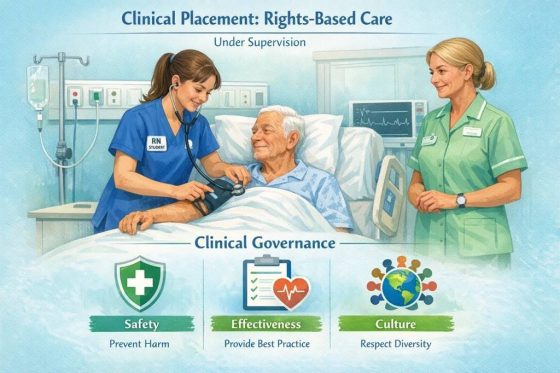
Clinical governance means being accountable. Nurses must act to protect safety, dignity, and quality of life. This links directly to AHPRA clinical governance and the NMBA standards.
A key change in 2026 is the Statement of Rights. In assignments, you must show how care supports a resident’s wellbeing. It is not enough to say care was given. You must explain how it improved comfort, choice, or independence.
For example, if a resident prefers to shower in the evening, documenting this choice shows respect for rights. It also proves patient-led care.
Another critical part is Incident Management Systems (IMS). Many students forget this in case studies. To meet Standard 1, you must mention:
- Reporting incidents
- Recording near-miss reporting
- Learning from errors
Near misses matter because they show a strong safety culture. Even when no harm occurs, reporting helps prevent future risks.
High Distinction papers clearly link actions to governance. They explain risks, responses, and follow-up steps. This shows academic focus and professional thinking.
If you are unsure how to link governance to practice, reviewing legal case study examples alongside nursing essays can help strengthen your understanding.
| Professional Standard | Action Required in Your Assignment | Link to 2026 Quality Standards |
| Standard 1: Thinks critically and analyses nursing practice | Did you use the Clinical Reasoning Cycle to justify a decision? | Standard 1: Supporting resident choice and autonomy |
| Standard 2: Engages in therapeutic and professional relationships | Did you document a Partnership Statement with the resident or family? | Standard 2: Partnering with consumers |
| Standard 3: Maintains the capability for practice | Did you mention seeking supervision or using evidence-based tools such as ISBAR? | Standard 5: Providing safe and effective clinical care |
| Standard 4: Comprehensively conducts assessments | Did you include physiological data (ADDS charts) and resident preferences? | Standard 5: Comprehensive Care (Nutrition, Skin, Hydration) |
| Standard 5: Develops a plan for nursing practice | Is your care plan rights-based rather than task-based? | Standard 1 & 2: Dignity of risk and person-led planning |
| Standard 6: Provides safe and appropriate nursing care | Did you apply Antimicrobial Stewardship or the 7 Rights of Medications? | Standard 3 & 4: Infection Control and Medication Safety |
| Standard 7: Evaluates outcomes to inform nursing practice | Did you reflect on the resident’s quality of life after the intervention? | Standard 1: Wellbeing and Quality of Life |
Standard 2: Partnering with Consumers
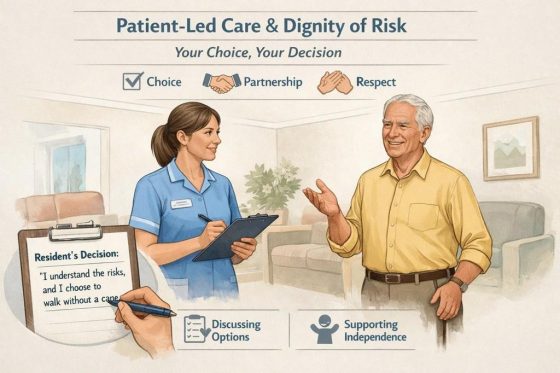
Standard 2 shifts care from patient-centred to patient-led care. This is where Dignity of Risk becomes essential.
Dignity of Risk means an older person has the right to make choices. Even if there is some risk, their decision still matters. For example, a resident may refuse a walker and choose to walk independently. The nurse’s role is not to force safety but to support informed choice.
In assignments, this must be written carefully. Markers look for balance. You must show:
- The resident understood the risk
- Alternatives were explained
- The final decision was respected
A strong care plan includes a Partnership Statement. This statement explains how the nurse and resident worked together. It often appears in nursing rubrics.
Example (simple format):
The resident was involved in all care decisions. Risks were explained in clear language. The resident chose to continue walking without a walker. This choice was respected and reviewed daily.
This approach meets the Strengthened Quality Standards and shows ethical practice.
Students writing care plan documentation should always link actions to the partnership. This proves you understand modern aged care values, not outdated task-based care.
If you need guided examples, structured nursing case study help can make these sections clearer and more confident.
Standard 3: Infection Prevention & Control
Infection control is a key nursing duty in aged care. After COVID, the rules became stricter. Under Strengthened Standard 3, nurses must show clear planning and action.
Hand hygiene is the starting point. Nurses must clean their hands before and after care. This reduces the spread of germs. But in 2026, this is not enough on its own.
Assignments must also discuss environmental safety. This means keeping shared areas clean. Bed rails, call bells, bathrooms, and walking aids must be wiped often. These areas carry a high risk.
Another major focus is Antimicrobial Stewardship (AMS). Antibiotics must be used carefully. Overuse can cause resistance. This makes infections harder to treat in older adults.
In case studies, students should explain:
- Why antibiotics were antibiotics given
- Why they were they delayed or stopped
- How infection signs were monitored
Nurses must also follow Standard Precautions. These include gloves, masks, and safe waste disposal. If an infection spreads, transmission-based precautions are added.
A strong assignment mentions an Outbreak Management Plan. This shows how staff respond to multiple cases. It may include isolation, testing, and reporting.
Clear infection planning shows safe practice. It also meets current Australian aged care rules.
Standard 4: Medication Safety
Medication safety was closely checked in 2026. The use of chemical restraints is now limited. Nurses must first try non-pharmacological interventions.
Chemical restraints are medicines used to control behaviour. They are not used for treatment. In dementia care, these drugs are only used as a last option.
Students must explain what was tried before medication. This may include:
- Calm speech
- Routine care times
- Reducing noise or stress
Another common mistake is missing Medication Reconciliation. This means checking all medicines a resident takes. It includes:
- Prescribed medicines
- Over-the-counter drugs
- Vitamins and herbal products
Older people often take many medicines. This is called polypharmacy. If it is ignored, assignments lose marks.
All case studies must list the 7 Rights of Medication Administration:
- Right patient
- Right drug
- Right dose
- Right route
- Right time
- Right reason
- Right documentation
These rights support QUM (Quality Use of Medicines). They protect patient safety and legal practice.
Good assignments explain how medication decisions reduced harm. This shows strong nursing judgment under Strengthened Standard 4.
Standard 5: Comprehensive Care
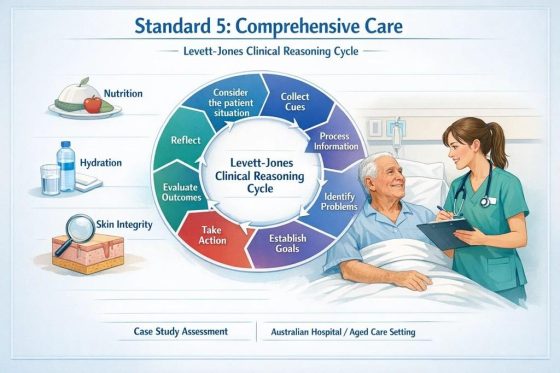
Standard 5 focuses on total care. It looks at the whole person. The key areas are nutrition, hydration, and skin integrity.
This standard links closely to the Clinical Reasoning Cycle (Levett-Jones). Australian nursing markers expect this structure.
The cycle includes:
- Assess
- Plan
- Implement
- Evaluate
Assessment means gathering information. This may include weight, food intake, skin checks, and fluid balance.
Planning means setting clear care goals. For example, improving meal intake or preventing skin breakdown.
Implementation is the action stage. Nurses may offer small meals, assist with fluids, or reposition the resident.
Evaluation checks if the care worked. If goals were not met, the plan is changed.
Nutrition is vital in aged care. Poor intake can lead to weakness and slow healing. Hydration prevents confusion and falls.
Skin integrity is also critical. Older skin is fragile. Pressure injuries must be prevented through regular checks and movement.
High-scoring assignments explain each step clearly. They show how care improved comfort and quality of life.
Using the Clinical Reasoning Cycle helps keep writing clear and organised. It also meets the 2026 marking standards.
Standard 6: Communicating for Safety
Clear communication saves lives. In aged care, many errors happen because information is missed or unclear. Under the 2026 standards, Communicating for Safety is a core nursing duty.
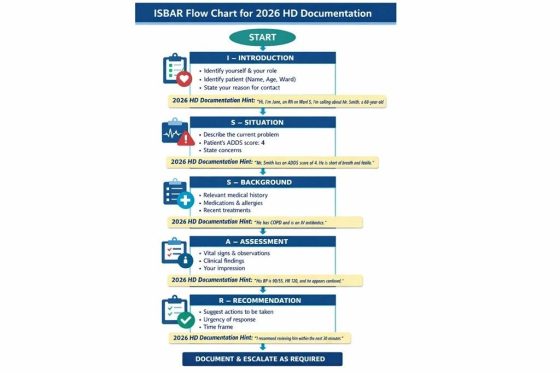
The main tool used is ISBAR. It stands for:
- Introduction
- Situation
- Background
- Assessment
- Recommendation
Professional Standard
Action Required in Your Assignment
Link to 2026 Quality Standards
Standard 1: Thinks critically and analyses nursing practice
Did you use the Clinical Reasoning Cycle to justify a decision?
Standard 1: Supporting resident choice and autonomy
Standard 2: Engages in therapeutic and professional relationships
Did you document a Partnership Statement with the resident or family?
Standard 2: Partnering with consumers
Standard 3: Maintains the capability for practice
Did you mention seeking supervision or using evidence-based tools such as ISBAR?
Standard 5: Providing safe and effective clinical care
Standard 4: Comprehensively conducts assessments
Did you include physiological data (ADDS charts) and resident preferences?
Standard 5: Comprehensive Care (Nutrition, Skin, Hydration)
Standard 5: Develops a plan for nursing practice
Is your care plan rights-based rather than task-based?
Standard 1 & 2: Dignity of risk and person-led planning
Standard 6: Provides safe and appropriate nursing care
Did you apply Antimicrobial Stewardship or the 7 Rights of Medications?
Standard 3 & 4: Infection Control and Medication Safety
Standard 7: Evaluates outcomes to inform nursing practice
Did you reflect on the resident’s quality of life after the intervention?
Standard 1: Wellbeing and Quality of Life
ISBAR is used during clinical handover, especially at shift change. It helps nurses share key facts in the same order every time.
In assignments, students should explain how ISBAR was used. For example, during a shift change, a nurse may report a resident’s pain level, vital signs, and care plan changes.
Failure to communicate is the top cause of clinical errors. This includes missed symptoms, wrong medicines, or delayed care.
Strong papers show clear handover steps. They explain how ISBAR reduced risk and improved teamwork.
If handover writing feels unclear, structured support can help with report tasks, which can improve flow and clarity.
Standard 7: Blood Management
Blood use is rare in residential aged care. However, students placed in acute geriatric wards must understand Blood Management.
The key rule is the 2-person check protocol. Two nurses must confirm:
Patient identity
- Blood product details
- Order accuracy
- This reduces serious errors.
Students should also mention haemovigilance. This means watching for signs of a transfusion reaction. These may include fever, rash, or shortness of breath.
Even a brief mention of safe checks shows strong safety awareness and meets standard requirements.
Standard 8: Recognising & Responding to Acute Deterioration
Older adults can deteriorate quickly. Standard 8 focuses on early action and response.
In Australia, nurses use the Between the Flags systems. These systems help spot warning signs early. Vital signs are recorded on ADDS charts.
ADDS scores show when a resident is getting worse. If scores rise, nurses must act. This may include closer checks or calling for help.
One key response is a MET Call. This is used when a resident’s condition becomes critical. Students must explain when and why this call was made.
Another important part is the Advanced Care Directives (ACD). These documents explain a resident’s care wishes. Some residents may have Non-Resuscitation (NFR) orders.
Nurses must respect these choices. During deterioration, care must follow the resident’s wishes and legal documents.
Assignments should clearly explain:
- What signs were noticed
- How was care escalated?
- How decisions followed the ACD
Strong writing shows calm judgment and safe response during acute deterioration.
If mental health or confusion is part of the case, support from a psychiatric mental health nurse assignment help can strengthen the analysis.
FAQs: 2026 Aged Care Nursing Assignments
Q1: Why can’t I use the 2018 Aged Care Quality Standards in 2026 assignments?
Ans: The 2018 standards are outdated. The Aged Care Act 2024/2025 introduced a rights-based model. Markers now expect the use of the Strengthened Quality Standards.
Using old standards leads to point deductions. They no longer match current care practice or legal rules.
Q2: How do I show Clinical Governance as a student nurse?
Ans: Students show Clinical Governance by identifying risks and acting early. This includes using Incident Management Systems (IMS) and reporting near misses.
Good papers show accountability and a strong safety culture. This supports High Distinction results.
Q3: What is the best way to structure an aged care case study?
Ans: The best structure is the Levett-Jones Clinical Reasoning Cycle. It helps organise care from assessment to review.
Link each stage to resident rights, safety, and well-being. This approach scores higher in Australian nursing rubrics.
For help, see guides on how to structure an Aged Care Case Study.
Q4: How do I write a Dignity of Risk statement safely?
Ans: Explain that the resident was informed. The risks were discussed clearly. State that the final choice was respected.
This supports Standard 2: Partnering with Consumers and shows ethical nursing practice.
Q5: Where can I find evidence-based templates for 2026 assignments?
Ans: Look for resources aligned with the 2026 Strengthened Standards and NMBA requirements. These include ISBAR templates and care plan models.
Using evidence-based templates improves structure without risking plagiarism.