 Blog
Score an A+: Mastering the 7 NMBA Standards for Perfect Nursing Reflective Journals (2026 Guide)
Blog
Score an A+: Mastering the 7 NMBA Standards for Perfect Nursing Reflective Journals (2026 Guide)
Score an A+: Mastering the 7 NMBA Standards for Perfect Nursing Reflective Journals (2026 Guide)
 Min Seow
 23 February,2026
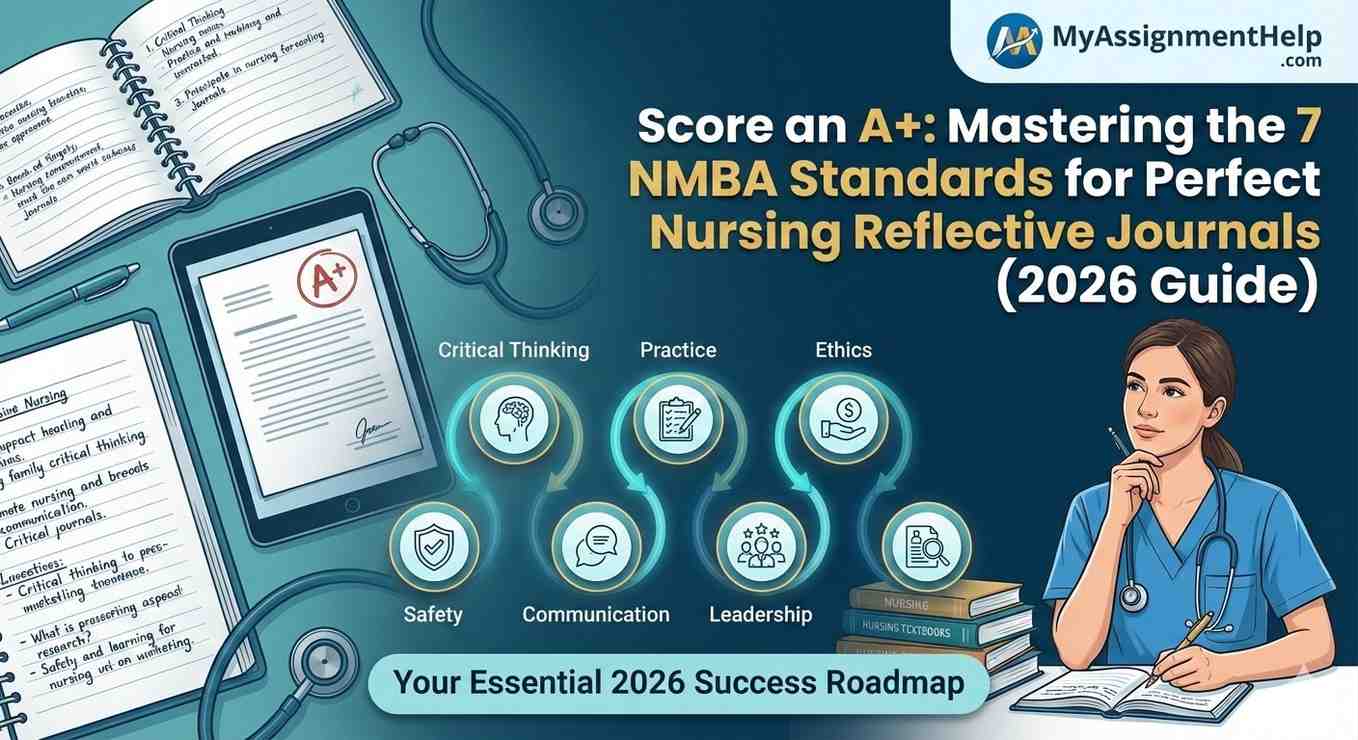
If you are a nursing student in Australia, you already know that the phrase “reflective journal” can spark a bit of anxiety. You spend your weeks on clinical placement learning how to handle complex patient care, only to be told you must write thousands of words about it. However, writing a nursing reflective journal isn’t just a hurdle to jump over; it is the most important way to prove you are ready to become a Registered Nurse.
In the world of Australian healthcare, the “gold standard” for everything we do is set by the Nursing and Midwifery Board of Australia (NMBA). To get an A+ on your journals, you must move beyond just telling a story. You must prove that your actions align with the NMBA Professional Standards.
This guide will walk you through exactly how to master the 7 NMBA Standards for Practice so you can submit a journal that markers love.
Why Reflection Matters in 2026
In 2026, the healthcare landscape is more digital and fast-paced than ever. With the recent 2026 NMBA Standards Review, there is an even higher focus on clinical reasoning and evidence-based practice.
Reflection is a “meta-cognitive” skill. That is a fancy way of saying “thinking about your thinking.” When you reflect, you are looking at your performance through the lens of the NMBA Standards for Practice. This process ensures that you aren’t just repeating tasks, but providing person-centred care that is safe and effective.
The Difference Between NMBA and AHPRA
- NMBA (The Rule-Makers): They set the Professional Standards (the “What” and “How” of nursing).
+2 - AHPRA (The Regulators): They implement the regulations, handle your registration, and keep the public safe by making sure nurses follow those NMBA standards.
The Connection to AHPRA
Every year, when you renew your registration with AHPRA, you declare that you have met your self-assessment and CPD (Continuing Professional Development) requirements. Your student journals are the “training wheels” for this professional habit. If you can master the NMBA competency standards now, your transition to a graduate nurse will be much smoother.
Deep Dive into the 7 NMBA Standards
To rank top globally, your journal needs to address these standards specifically. Let’s break down each one into simple terms and see how they fit into your writing.
Standard 1: Thinks critically and analyses nursing practice
This is the most important standard for academic writing. It asks: Do you know why you did what you did?
- What it means: You don’t just follow a checklist. You use clinical reasoning to look at a patient’s situation and decide on the best path.
- Keyword Integration: When writing, use terms like evidence-based practice. For example: “I researched the latest clinical guidelines to ensure my intervention was backed by current evidence.”
- A+ Tip: Mention that you didn’t just accept a situation at face value. You analyzed the “vitals” and the “context.”
Standard 2: Engages in therapeutic and professional relationships
Nursing is a team sport, and the patient is the captain of that team.
- What it means: You must communicate well with patients (therapeutic) and work effectively with your colleagues (professional).
- Keyword Integration: Focus on person-centred care and professional boundaries in nursing.
- A+ Tip: Reflect on a time a patient was upset. How did you use communication to calm them while maintaining a professional distance?
Standard 3: Maintains the capability for practice
This standard is about your “fitness” to be a nurse.
- What it means: You know what you know, and you know what you don’t know. You are responsible for your own learning.
- Keyword Integration: This is where you talk about capability for practice and self-assessment.
- A+ Tip: Be honest! Writing about a mistake or a gap in your knowledge shows high capability for practice because it shows you are willing to learn.
Standard 4: Comprehensively conducts assessments
You cannot treat what you haven’t assessed.
- What it means: You use your senses (sight, touch, hearing) and tools (monitors, charts) to get a full picture of the patient.
- Keyword Integration: Use the phrase comprehensive assessment.
- A+ Tip: Don’t just list what you did. Explain what you were looking for. “I performed a comprehensive assessment of the skin integrity to check for early signs of pressure injuries.”
Focus on Cultural Safety & Humility
- In 2026, you must reflect on how you provide care to Aboriginal and Torres Strait Islander peoples.
- Don’t just be “aware” of culture; practice Cultural Humility. This means reflecting on your own biases and listening to the patient as the expert of their own life.
Standard 5: Develops a plan for nursing practice
Now that you have the info, what is the plan?
- What it means: You work with the patient and the healthcare team to set goals.
- Keyword Integration: Highlight collaborative nursing practice.
- A+ Tip: Describe how you talked to the doctor or the physiotherapist. This shows you understand that nursing doesn’t happen in a vacuum.
Standard 6: Provides safe and quality nursing practice
This is the “Safety Standard.”
- What it means: You follow the rules to keep the patient safe. It also involves Delegation. As an RN, you are responsible for providing “effective and timely direction and supervision” to those you delegate tasks to (like AINs or ENs).
+2 - Keyword Integration: Use provision of safe and quality care, accountability, and delegation and supervision.
- A+ Tip: If you asked a senior nurse to supervise you while you gave an injection, you met this standard perfectly. You showed accountability.
Standard 7: Evaluates outcomes to inform nursing practice
The final step, did it work?
- What it means: You look at the results of your care and change the plan if the patient isn’t getting better.
- Keyword Integration: Focus on evaluating patient outcomes.
- A+ Tip: Writing about a plan that didn’t work is actually a great way to get an A+, as long as you explain how you fixed it.
Standard Mapping Table: Seeing the “Big Picture”
Many students make the mistake of thinking one event equals one standard. In reality, a single clinical moment often touches several standards at once.
| Clinical Event | Primary Standard | Overlapping Standards |
|---|---|---|
| Correcting a dose of medication before giving it. | Standard 6: Providing safe care. | Standard 1: Critical thinking and Standard 3: Capability/Safety limits. |
| Asking an EN to monitor vitals while you help a doctor. | Standard 6: Effective delegation. | Standard 5: Planning practice and Standard 2: Professional relationships. |
| Discussing a care plan with an Indigenous Elder. | Standard 2: Therapeutic relationships. | Standard 4: Cultural safety in assessment and Standard 5: Collaborative planning. |
| Looking up a new policy on wound management. | Standard 1: Evidence-based practice. | Standard 3: Maintaining capability/CPD. |
Choosing the Right Nursing Reflection Models
You cannot just write a “brain dump.” You need a structure. While there are many nursing reflection models, two stand out for Australian students.
1. Gibbs Reflective Cycle (The Fan Favorite)
Gibbs is a perfect nursing reflective journal because it is detailed. It has six stages:
- Description: What happened?
- Feelings: What were you thinking?
- Evaluation: What was good or bad?
- Analysis: Where you link to NMBA standards.
- Conclusion: What else could you have done?
- Action Plan: What will you do next time?
2. Borton’s Model (The Simple Choice)
If you are struggling with word count or have a very simple story, use “What? So What? Now What?”.
- What? (The event)
- So What? (The importance link to clinical reasoning. Link the event to the NMBA Standards and the Code of Conduct. This shows you understand your professional responsibilities at a much deeper level.)
- Now What? (The future link to capability for practice)
How to Write the “Analysis” Section (The Mark-Winner)
The Analysis section of your nursing reflective journal is where you earn 80% of your marks. This is where you prove you are a scientist and a professional.
To master this, use the “Standard Mapping” technique. Pick one of the NMBA Professional Standards and weave it into your sentences.
Example of a “C” grade sentence:
“I made sure the patient was comfortable during the dressing change.”
Example of an “A+” grade sentence:
“By constantly asking the patient for feedback during the dressing change, I practiced person-centred care (Standard 2). I used clinical reasoning (Standard 1) to assess that the wound was healing well, which helped me in evaluating patient outcomes (Standard 7).”
See the difference? The second sentence uses the “language of the board.”
For better assistance, you can always use trained and experienced experts from the field in My Assignment Help Australia. They have been the solution for thousands of students.
Mastering Clinical Placements Reflection
Your clinical placements reflection should cover different areas of nursing. To rank globally, we should look at three main areas:
1. Medication Safety
Reflecting on meds is a great way to show provision of safe and quality care. Talk about the “7 Rights” of medication administration and how you maintained accountability and delegation.
2. Communication with the MDT
The Multi-Disciplinary Team (MDT) includes everyone from doctors to cleaners. Reflecting on a handover shows collaborative nursing practice.
3. Patient Advocacy
If a patient didn’t want a treatment and you spoke up for them, you are demonstrating professional boundaries in nursing and therapeutic relationships.
Using the Nursing Reflection Marking Rubric to Your Advantage
Before you submit, you should look at your university’s nursing reflection marking rubric. Most rubrics look for three things:
- Criticality: Did you move beyond just “describing”?
- Linking: Did you cite the Registered Nurse Standards for Practice?
- Grammar & Flow: Is it easy to read? (Aiming for that Grade 7 FK level!).
The “A+” Checklist:
- [ ] Did I mention at least 3 NMBA Standards?
- [ ] Did I use a recognized nursing reflection model like Gibbs?
- [ ] Did I mention evidence-based practice?
- [ ] Is my person-centred care clear?
- [ ] Did I maintain patient confidentiality?
- [ ] Privacy & Anonymity: Did I redact every single piece of identifying info (Patient names, ID numbers, or specific Hospital names)?. Remember: Sharing private info is a breach of AHPRA standards and usually results in an automatic fail.
Part 7: Common Pitfalls (And How to Avoid Them)
Even the best students make mistakes. Here are the top three reasons students miss out on an A+:
- Too Much Description: If your “Description” section is longer than your “Analysis,” you will lose marks. Google and your markers both want “Deep Content.”
- Weak Action Plans: Don’t just say “I will do better next time.” Say “I will engage in self-assessment and CPD by completing an online module on wound care.”
- Forgetting the “Professional”: Always remember that you are a professional in training. Avoid slang and keep your tone respectful toward colleagues.
Example Reflection – Standard 6 (Safety)
During my third week of placement, I was asked to help move a patient who had a high risk of falls. I realised that the patient required a mechanical lifter, which I had not checked off on yet. According to NMBA Standard 6, I am responsible for the provision of safe and quality care. If I had moved the patient alone, I would have been operating outside my capability for practice.
I used clinical reasoning to stop and ask my facilitator for help. This showed accountability. We worked together, demonstrating collaborative nursing practice. This experience taught me that being a good nurse isn’t about knowing everything; it’s about knowing when to ask for help to ensure patient outcomes remain positive.
Conclusion: Your Path to an A+
Mastering the 7 NMBA Standards is the key to unlocking your nursing career. When you write your next nursing reflective journal, don’t see it as a chore. See it as your chance to prove that you have the clinical reasoning, the empathy for person-centred care, and the professionalism to join the ranks of Australia’s Registered Nurses.
By following the Gibbs Reflective Cycle and mapping your actions to the NMBA Professional Standards, you aren’t just writing a paper you are building your professional identity.
FAQs for Global Nursing Success
1. What are the 7 standards of nursing in Australia for 2026?
The 7 NMBA Standards for Practice are the core requirements for all Registered Nurses. They include:
- Critical Thinking
- Therapeutic/Professional Relationships
- Capability for Practice
- Comprehensive Assessment
- Planning Practice
- Safe and Quality Care
- Evaluating Outcomes.
In 2026, the NMBA is currently reviewing these to further emphasise digital health literacy and cultural safety.
2. How do I choose which cultural safety NMBA standard to use in my reflection?
You don’t need to use all seven. For an A+ grade, pick the 1 or 2 standards that most naturally fit your story. If you’re writing about a communication error, focus on Standard 2 (Relationships). If you’re writing about a clinical mistake, focus on Standard 6 (Safe Practice) and Standard 3 (Capability).
3. Why is the “Analysis” stage of Gibbs the most important for my grade?
The Analysis stage is where you move from “what happened” to “why it matters.” This is where markers look for your ability to link a real-life event to evidence-based practice and the NMBA competency standards. Without a strong analysis, your journal is just a diary entry, not a professional reflection.
4. Can I mention more than one reflection model?
While you should use one model (like Gibbs Reflective Cycle) to structure your whole paper, you can mention others in your analysis. For example, you might say, “While Gibbs helps me look at my feelings, using Borton’s ‘So What?’ approach helped me realise the clinical significance of my assessment (Standard 4).”
5. How do the 2026 NMBA updates affect my reflective writing?
The 2026 updates place a massive focus on cultural safety and accountability. When you reflect, make sure to explicitly state how you respected the patient’s cultural background or how you took responsibility for your actions under Standard 6. This shows you are up-to-date with current Australian regulations
6. How do I link the 2016 standards to my 2026 journal?
While the standards were created in 2016, they are updated through “Fact Sheets” and “Guidance Notes.” Always check the NMBA website for the 2026 updates on digital health and cultural safety.