
Mastering Therapeutic Communication: A Case Study Guide for Mental Health Students
 Min Seow
 16 February,2026
One of the most important skills of mental health nursing is therapeutic communication. Students can not understand how to use the proper words. They also feel confused about body language and clinical judgment. Because of this, they lose confidence.
This guide makes the topic simple. It explains the main ideas in clear steps. It also shows how to use them in case studies. After reading this guide, you will feel more confident when talking to clients. It will also help you in nursing assessments and practical work. It will become easy to work on an assessment in nursing or just improve your practical skills.
You can look for additional help from experts for the assessment. MyAssignmentHelp offers local help from Australian mental health care professionals.
Understanding the Role of Therapeutic Communication in Mental Health Nursing
Therapeutic communication involves using direct, kind, and respectful words to encourage a client. It also makes you know how they feel and takes them out of trouble. It keeps them safe. This skill is very important in therapeutic communication and mental health nursing. Most clients experience fear, emotion, or confusion. The mental health case study guide approach describes the fundamentals simply. It helps the students to master the steps one by one. To get more guidance, you can explore mental health nursing case studies.
Most students face issues in mastering and understanding this skill. They usually are not sure about what to say and how to react. Students are also confused about how not to act and how to deal with silence. Even some of them can not understand what cues are important and how to show empathy without being rude or in a hurry. This guide will state these problems for your easy understanding. You will get clear examples, safe questions and simple actions that you can follow.
The importance of therapeutic communication is that it keeps the clients safe and develops trust. Clients feel respected when you talk with a calm voice and listen carefully. This promotes healing and lowers suffering. You also get a good assessment and write case studies through strong communication. Nursing assignment help can help you build these skills. Once you complete your mental health case study guide, you get strong communication.
1. Defining Therapeutic Communication in 2026: Trauma-Informed Care
Trauma-Informed Care (TIC) shapes therapeutic communication in 2026. TIC also guides nurses to gain knowledge about the impact of past trauma. Nurses understand the way past trauma affects a person’s reaction, emotions, and safety. This helps to speak softly in mental health nursing in Australia. It also helps nurses to use clear words. Nurses can make the clients feel respected and listened to.
This approach focuses on:
- Safety
- Respect
- Choice
- Trust
Recovery-Oriented practice is also followed under modern care. This model gives its priority on hope, choice and strengths. The client improves their recovery by themselves. This is supported by a good nurse through becoming a good listener. Nurses also need to ask safe questions and be non-judgmental. Communication is helpful for the client to feel in control of the journey.
One Trauma-Informed Care practice involves:
- Make sure the client feels safe
- using simple, steady, and calm language
- respecting the client’s choices and pacing
- avoiding triggers or emotional questions
- Let the client speak at their own paceMake sure the client feels safe
- using simple, steady, and calm language
- respecting the client’s choices and pacing
- avoiding triggers or emotional questions
- Let the client speak at their own pace
TIC and Recovery-Oriented practices are used together to develop trust. Whenever students use these ideas, they can communicate in the most effective, safe and kind way. The result is improved mental health care therapeutic relationships. It also helps you to get better outcomes.
2. The Core Frameworks: NMBA Standards & Peplau’s Theory
Safe and strong communication in mental health care is guided by two major frameworks. These practices help students in creating good therapeutic nurse-patient relationships. The first framework is NMBA Standard 2. This practice focuses on respect for client-centred communication. It also involves culturally safe communication. This practice helps nurses develop the ability to listen with empathy.
It focuses on:
- Listen with empathy
- Use clear language
- Respect culture
- Protect dignity
The standards also help nurses to focus on client preferences. It also helps to develop trust in all the interactions with clients. It shapes the responses of mental health nurses towards distress and boundary setting. Nurses also keep the dignity of a client safe. The NMBA Standards for Practice link can help the students to learn more.
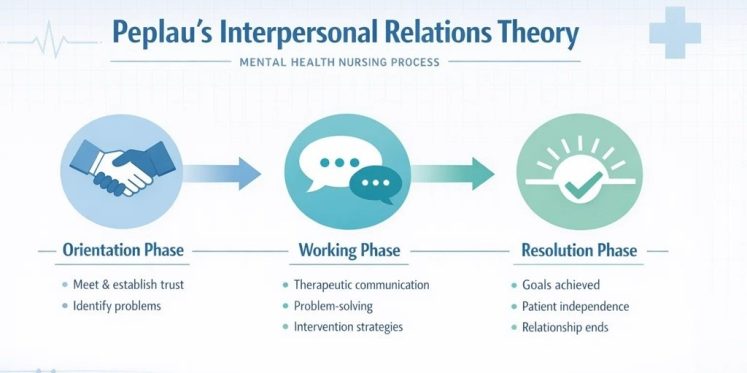
The second important theory is Peplau’s theory of interpersonal relations. This theory was written by Hildegard Peplau. Peplau states, nursing is not simply a job. It is a relationship that gets built through communication. As per her theory, there are three phases in one-to-one communication. These are orientation, working and resolution. The different stages need a clear, calm, and supportive process of communication.
She described three stages:
- Orientation – Build trust
- Working – Explore feelings and problems
- Resolution – Support independence
- Nurses may act as:
- Teacher
- Counsellor
- Support person
During the orientation stage, nurses can build trust. In the working stage, nurses get into their thoughts and emotions. They need to cope with the needs of clients. During the resolution stage, nurses guide the clients to be independent. Some of the other roles are also stated in this theory. It talks about the role of the teacher, counsellor, and resource person. These roles guide the nurses on how to interact with the clients.
Both NMBA Standard 2 and the theory of Peplau are important for mental health nursing students. It offers a strong base to know and understand the process of communication. They educate you on the ability to listen to others. You will also learn to respect and guide the healing process. You can use an expert, steady, and understanding communication process.
3. Step-by-Step: Writing a Mental Health Case Study
It is hard to write a mental health case study for students. Let this guide clear your idea about writing a mental health case study. You can easily write it following a clear structure. This section shows an easy and simple mental health nursing case study guide. It will guide you to write a clear, simple and structured work. Most of the students feel confused about what they should collect. They are also unsure about how they will examine the cues and how they will plan objectives. The Levett-Jones Clinical reasoning cycle guides you to think in an orderly way. It will help you use HD nursing assignment tips. If you want, you can get further advice on the Clinical Reasoning Cycle.
A mental health case study tends to take three easy steps. These steps are:
- Assessment
- Analysis
- Planning
3.1 Step 1: Assessment & Collecting Cues (MSE)
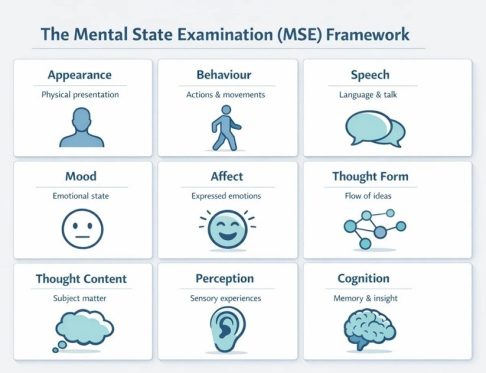
Assessment begins with noticing psych nursing cues through the Mental State Examination. The Mental State Examination student guide helps you follow the right sequence when learning how to conduct MSE nursing. You look at MSE domains such as appearance, behaviour, speech, mood, affect, thought form, thought content, perception, and cognition.
Thought form vs content is important.
Form shows how the client thinks.
Content shows what the client thinks.
This helps when assessing mood and affect nursing and making sense of client behaviour.
Look at:
- Appearance
- Behaviour
- Speech
- Mood
- Affect
- Thought form
- Thought content
- Perception
- Cognition
- Insight.
Non-Verbal Cues
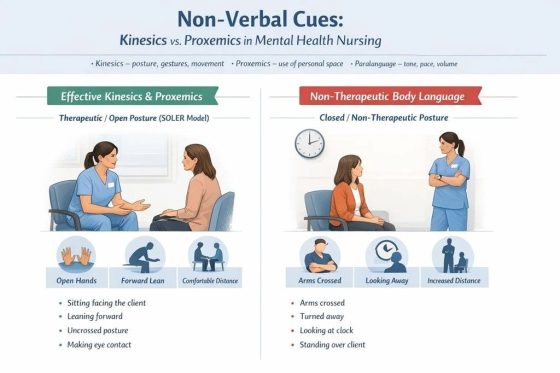
Non-verbal communication provides additional details.
posture, gestures, and movement (kinesics in nursing)
personal space and tone (proxemics and paralanguage)
pressured speech mania
signs of fear, distress, or confusion
These therapeutic communication cues help you understand the client more clearly.
3.2 Step 2: Analysis & Processing Information
After you gather the cues, the next step is to think about what they mean. This stage is about identifying nursing problems in mental health and forming a possible psych nursing diagnosis. You look at all the MSE data and find patterns. These patterns help you understand the client’s needs, risks, and feelings.
Start by asking simple questions:
- What cue stands out the most?
- What does this behaviour show?
- Is the client safe?
What emotional needs do they have right now?
When interpreting MSE data, compare the cues with common presentations. Notice changes in mood, speech, behaviour, and thinking. These signs can point to important concerns.
Withdrawal – may suggest social isolation
poor hygiene – may suggest self-care deficit
This step uses clinical interpretation to understand what the client needs most.
3.3 Step 3: Establishing Goals & Implementation
Your last step is planning action. Recovery plans must follow Recovery-oriented nursing goals. For more help, visit Recovery-Oriented nursing goals.
A quick plan includes:
- clear, simple goals
- therapeutic communication techniques
- useful mental health nursing interventions
- de-escalation rationales for safety
- coping strategies for anxiety
- client involvement in choices
This brings the whole case study together and shows safe, supportive care.
4. Clinical Scenarios: High-Distinction vs. Pass Responses
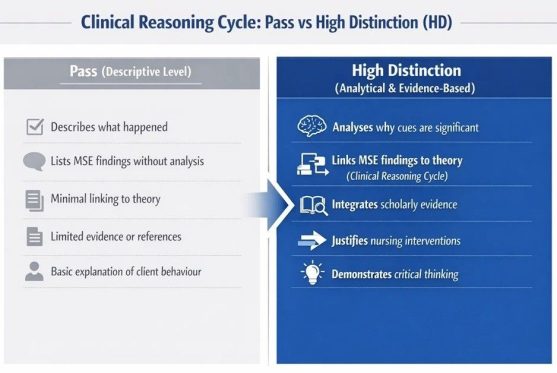
Understanding the difference between a Pass and a High-Distinction response helps students improve their writing. When looking at psychiatric nursing case study examples, many students describe the scenario but do not explain why the cues matter. They often miss the link between client behaviour, MSE findings, and therapeutic communication techniques. HD responses, however, show deeper reasoning and explain how the nurse uses communication to support the client.
Common features of a Pass response include:
- listing cues with no interpretation
- describing actions but not the reason behind them
- weak links to MSE domains
- Minimal focus on communication skills
- no clear recovery-focused explanation
A High-Distinction response goes further. It shows clear thinking and strong analysis. HD students explain why a behaviour matters, how it affects engagement, and what communication strategy fits best. They also connect MSE data to risk, safety, and the client’s emotional needs. These responses show a full understanding of the client’s situation and the nurse’s role.
Strong HD responses often include:
- clear meaning behind each cue
- accurate links to MSE findings
- correct use of therapeutic communication techniques
- recovery-focused reasoning
- evidence-based analysis and safe planning
HD responses stand out because they show deeper understanding, stronger judgment, and clearer communication. They reflect careful thinking and support safer, more effective client care.
5. Avoiding Common Traps in Mental Health Assignments
Many students lose marks in mental health assessments because they repeat the same simple mistakes. One major issue is mixing up objective vs. subjective data in nursing. Objective data is what you can see or measure. Subjective data is what the client says or feels. When these are confused, the case study becomes unclear, and the clinical reasoning becomes weak. Another common problem is using non-therapeutic communication, such as giving advice too quickly, judging the client, or speaking in a rushed tone. These errors impact safety and lower the assignment grade.
Common traps to avoid:
- writing long descriptions with no analysis
- giving opinions instead of evidence
- ignoring MSE cues
- using judgmental or rushed language
- poor structure and unclear goals
To improve your work, try connecting each cue to meaning and safety. Reflect on your communication choices and focus on supportive interactions. For deeper learning, explore reflective writing in nursing to strengthen your analysis.
FAQs About Therapeutic Communication Case Study
Q.1 How do I link therapeutic communication to the NMBA Standards?
Linking NMBA Standards to the nursing assignments focuses on communication. It shows the way communication supports safe and respectful care. NMBA Standard 2 psych nursing guides a nurse to build trust. It helps them to be a listener with empathy. It uses simple language. Show how your therapeutic communication practices match these expectations. Highlight the way your words, tone, and actions make sure clients are safe. It also supports the fast healing of clients.
Q.2 What is ‘Dignity of Risk’ in an Australian mental health context?
Dignity of Risk, Mental Health Australia helps clients to make their own choices, even if the clients make risky decisions. It still supports the client to choose it. It has a rights-based nursing model that gives value to independence and choice. This model is rooted in rights and aligns with the principles of the Mental Health Act. It also follows the Aged Care Act 2024/2025 and considers the framework of NSQHS Standards vs. Aged Care Standards , ensuring care is both safe and person-centred. Nurses can safely make decisions while balancing clinical responsibility with individual autonomy. At the same time, they do not violate the rights and welfare of the client.
Q.3 Can I use the Clinical Reasoning Cycle for psychiatric nursing assignments?
Yes. The clinical reasoning cycle for mental health is very useful for structuring psychiatric assessments. In Levett-Jones mental health nursing, the most important step is “Collect Cues.” This helps you notice behaviour, mood, speech, and safety signs. Using the cycle shows clear thinking and helps you explain your decisions in a simple, organised way.
Q.4 : What are the key components of a Mental State Examination (MSE) for students?
The MSE nursing student guide is essential for nursing students. It states the way nurses can assess the mental health condition of a client.
The key Mental State Examination Components are,
Cognition and Insight.
Appearance,
Behaviour,
Speech,
Mood,
Affect,
Thought Form,
Thought Content,
Perception,
These areas guide students to learn about the thinking process of a client. It also helps them to learn about their feelings. They can offer proper responses to the client. It also guides in the safe and correct writing of case studies.
Q.5 Why is Trauma-Informed Care (TIC) essential in 2026 nursing assignments?
The trauma-informed care nursing assignment focuses on learning the impacts of past experiences. It studies the past situation’s impact on the client’s behaviour and safety needs. TIC is very important for the 2026 nursing standards in Australia. It supports Safety and Trust. It also prefers the clients’ Choice. All these pillars are made for the nurses to talk softly. It also lowers triggers and supports choices. TIC-based assessment is make sure high quality of care. It also supports the healing-first approach to care.
Conclusion: Moving Forward with Confidence
Therapeutic communication is more than just speaking kindly. It is about building a real connection. In mental health nursing, your words, tone, and body language can make a big difference. A calm voice can reduce fear. A simple question can open up trust. A moment of silence can show respect.
This guide has shown you clear and practical steps. You learned how to collect cues, understand behaviour, and plan safe care. You also saw how frameworks like NMBA Standard 2, Peplau’s stages, and Trauma-Informed Care support respectful practice. When you apply these ideas, your case studies become stronger and more meaningful. If you ever seek structured academic support, an assignment writing service can also guide you in presenting these frameworks clearly and professionally.
Remember, strong answers do not only describe what happened. They explain why it matters. They connect communication to safety, dignity, and recovery. This is what makes your work stand out.
Keep practising. Read cues carefully. Think before you respond. Stay calm and supportive. With time and effort, your confidence will grow. Clear thinking and kind communication will not only improve your grades but also help you become a safe, skilled, and compassionate mental health nurse ready for real-world practice.